New Well Installation — Complete Guide
Planning a brand-new well on land that has never had water service is one of the biggest unknowns in a rural build. You need to know whether your property can support a well, what the water well drilling cost will actually be, and how the project fits into your construction timeline. This guide covers the full process for Gresham, Sandy, Boring, Damascus, and the surrounding Clackamas and Multnomah County edge, where private wells are the norm. Instead of vague "it depends" answers, you will find real local depth expectations, cost drivers, and permit requirements built from actual jobs drilled in this area. By the end, you should be able to plan and budget for a new well with confidence.
What You'll Find in This Guide
What Drives Water Well Drilling Cost on the East Portland Metro Edge
Every well quote comes down to a handful of variables. Depth matters most, followed by ground conditions, casing requirements, and the pump system you install at the end. However, most national figures flatten those variables into a single number, which is why they rarely match what you pay here.
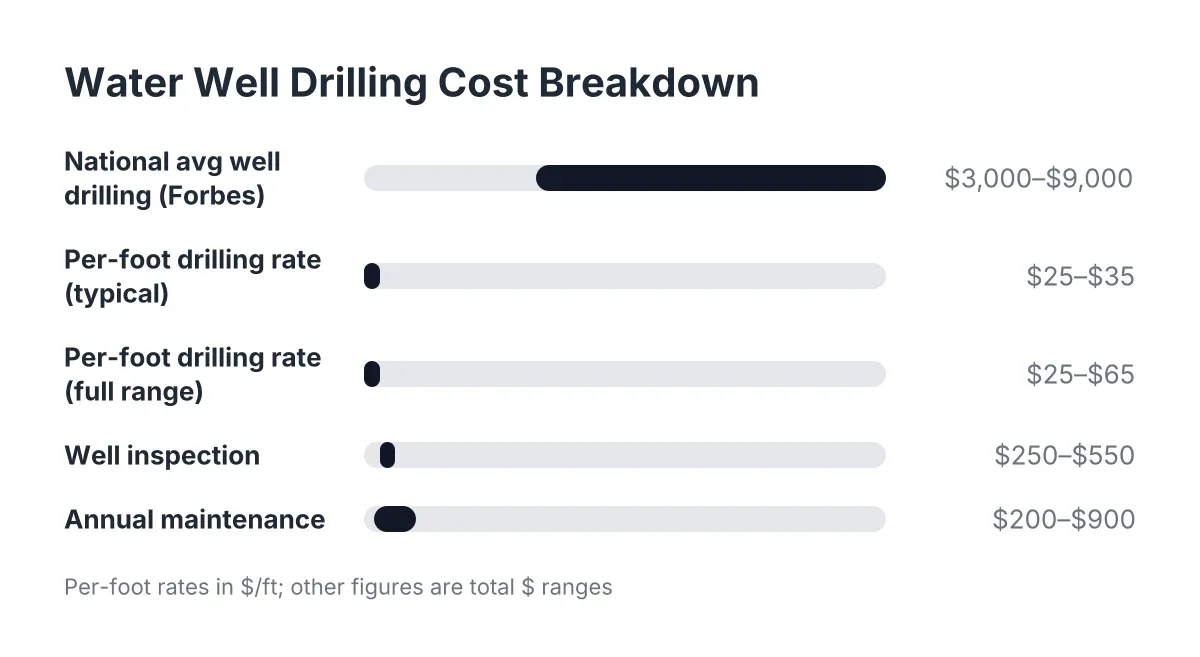
For context, the average cost to drill a well nationally is $5,625, with typical projects landing between $3,000 and $9,000, according to Forbes. Per-foot pricing tells a similar story. Angi puts the average cost to drill a well at $25 to $65 per foot, with $25 to $35 per foot as a common residential guideline. Those numbers are a useful floor. That said, they assume average depth and average geology, and the Gresham area does not always cooperate with either.
Why Local Geology Changes the Math
East of Portland, the ground shifts fast. Properties near Gresham and Damascus often sit on old lava flows and dense basalt, while parcels toward Sandy and Boring can hit glacial till, clay layers, and boulder fields left by ancient floods. As a result, two properties a mile apart can require very different drilling depths and casing lengths. Harder rock slows the drill and raises the per-foot rate. Deeper water tables add footage. Additionally, unstable overburden means more steel casing, which is one of the larger line items on any invoice.
This is why a local per-foot number matters more than a national average. If your parcel needs 300 feet through basalt, your water well drilling cost will look nothing like a 120-foot well in soft sediment. We break down the three biggest price drivers, with ranges from real local jobs, in our guide to how much new well installation costs.
Beyond drilling itself, budget for the full system. A complete new well includes the pump, pressure tank, wiring, trenching to the house, and a well seal. In practice, the pump system alone can add several thousand dollars to the drilling total. With this in mind, treat any quote that only covers the borehole as a partial number, not a project budget.
How Deep Wells Need to Be Drilled Around Gresham, and Whether You Have Water
"Do I have water on my property?" is usually the first question a land buyer asks. The honest answer is that almost every parcel in this region sits above groundwater at some depth. Consequently, the real question is not whether water exists, but how deep it is, how much the well will produce, and what it costs to reach it.
Typical Depth Expectations in This Area
Depth varies widely across the Gresham and east metro area. Some wells near Corbett and along the Sandy River corridor hit productive water in shallower alluvial layers. Meanwhile, wells drilled into the basalt uplands around Damascus, Boring, and Estacada often need to go considerably deeper to reach fractured rock that carries water. Because of this, depth is the single biggest reason quotes vary from one property to the next.
Fortunately, you do not have to guess. Oregon requires every licensed driller to file a well log for each well completed, and those logs are public. You can search well records for neighboring parcels through the Oregon Water Resources Department, which shows the depth, yield, and geology drillers encountered nearby. For example, if three neighbors hit water between 180 and 240 feet, you have a realistic planning range before a rig ever arrives. A good local driller will pull these logs for you as part of an aquifer and well depth assessment.
Yield Matters as Much as Depth
Reaching water is only half the goal. Additionally, the well needs to produce enough flow to run a household, typically measured in gallons per minute. A deep well with strong yield beats a shallow well that runs dry in August. Low-yield wells can still work with larger storage tanks, but that adds cost and complexity. Therefore, ask about expected yield, not just expected depth, when you compare estimates. Neighboring well logs give you a preview of both, and they help a driller pick the most promising spot on your parcel.
Permits, Timeline, and Planning a Well for New Construction
A new well is not just a drilling job. It is a permitted, inspected, and documented piece of infrastructure, and it needs to land in the right sequence within your build. Getting the order wrong can stall a construction loan or delay occupancy, so plan the well early.
New Well Permit Requirements in Oregon
Oregon regulates well construction at the state level. Before drilling starts, your driller files a start card with the Oregon Water Resources Department, and the state collects a fee. In addition, the well must meet construction standards for casing, sealing, and setbacks from septic systems and property lines. Most single-family domestic wells fall under Oregon's exempt use rules, which means you do not need a separate water right for ordinary household use. However, county land use rules still apply, and lenders often require proof of a viable water source before funding new construction. A licensed local driller handles the state paperwork as part of the job, so your main task is confirming setbacks and site access early.
A Realistic Timeline for New Construction
For most projects, the sequence looks like this: site assessment and well log research first, then drilling, then pump installation, then water testing. Drilling itself usually takes one to a few days once the rig is on site. That said, scheduling is the real variable. Rig availability, weather, and permit processing can stretch the calendar, so start the well conversation two to three months before you need water on site.
Water testing comes last, and it matters for more than peace of mind. Lenders and county sanitation offices often require a passing test for coliform bacteria, nitrates, and arsenic before they sign off on a new home. Similarly, if you are buying land with an existing well, a professional inspection protects you before closing. According to Angi, a typical professional well inspection costs $250 to $550, which is small money against the price of a failed water source. Build both testing and inspection into your project plan, not as afterthoughts.
Budgeting for Water Well Drilling Costs and System Installation
The drilling invoice gets the most attention, but it is only part of the total water well drilling cost for a livable property. To put it simply, you are buying a complete water system: the borehole, the casing, the pump, the pressure tank, the trench to your home, and the controls that tie it all together.
The Pump System and Beyond
The pump is the heart of the system, and it is a meaningful expense on its own. For reference, Angi reports a national average well pump replacement cost of $1,898, with most homeowners paying between $975 and $2,821. On a new installation, pump sizing depends on your well depth and yield, so deeper wells generally need more powerful and more expensive pumps. Additionally, trenching from the wellhead to the house, running electrical, and installing the pressure tank all add labor and materials that vary with your site layout.
Plan for ongoing costs too. Wells are low-maintenance compared to many home systems, but they are not zero-maintenance. Periodic water testing, occasional inspections, and eventual pump replacement are all part of well ownership. HomeAdvisor notes that most homeowners need to drill or re-drill a well every 10 to 20 years, though a properly constructed well in stable geology often lasts far longer. Because of that range, construction quality on day one is the best money you will ever spend on your water system.
How to Compare Quotes Intelligently
When quotes arrive, compare them line by line rather than by the bottom number. First, confirm each quote assumes a similar depth range based on neighboring well logs. Next, check what happens if the drill has to go deeper, since per-foot overage rates vary between companies. Then verify the quote includes casing, sealing, the pump system, and the state fee. Finally, ask who handles the permit filing and the final water test. Our new well installation cost guide walks through these comparisons in detail, so you can spot a padded quote or a suspiciously thin one before you sign.
Ready to Get Started?
If you are planning a build on land around Gresham, Sandy, Boring, or Damascus, the smartest first step is a site-specific depth and cost assessment based on real well logs from your neighborhood. We drill in this ground every week, and we will give you straight numbers instead of a shrug. Reach out and tell us where your parcel is, and we will tell you what the ground under it is likely to hold.