Well Inspection — Complete Guide
A water well inspection tells you whether the well on a property actually works, how long it should keep working, and whether the water is safe to drink. If you are buying a home on a private well in Gresham, Sandy, Boring, Damascus, or anywhere on the rural edge of Clackamas and Multnomah County, this matters more than almost anything else in your inspection period. City buyers get a water bill; well buyers get a mechanical system with a finite lifespan and no paper trail unless someone documents it. This guide explains what a professional well inspection includes, why real estate transactions raise the stakes, and how to read the report you get back. You will also find links to our deeper articles on cost and related topics as we build out this resource.
What You'll Find in This Guide
What a Water Well Inspection Actually Covers
A real inspection covers three systems: the well itself, the pump and pressure system, and water quality. Most buyers assume inspection means looking down the hole, but professionals examine all three.
The well portion starts at the wellhead. Your inspector checks the casing height, cap, seal, grading, and distance to septic systems and contamination sources. They pull the well log if one exists, revealing drilled depth, static water level at construction, and original yield. Oregon requires well logs on new construction for decades, so a missing log indicates the well's age.
The pump and pressure system receives mechanical scrutiny: pump amperage draw, pressure tank air charge and bladder condition, pressure switch settings, and wiring. A good inspector runs a flow test, drawing water sustained to measure gallons per minute delivered today. A well producing 15 GPM in 1988 may deliver 4 today—only a flow test reveals that decline.
Water quality testing completes the picture. Test for total coliform bacteria, nitrates, and arsenic through a certified lab. These are Oregon-flagged contaminants for real estate transactions—invisible, tasteless, and common in our region. The U.S. Environmental Protection Agency reports a USGS study of 2,100 private wells found roughly one in five contained at least one contaminant above human-health benchmarks. This is why testing exists.
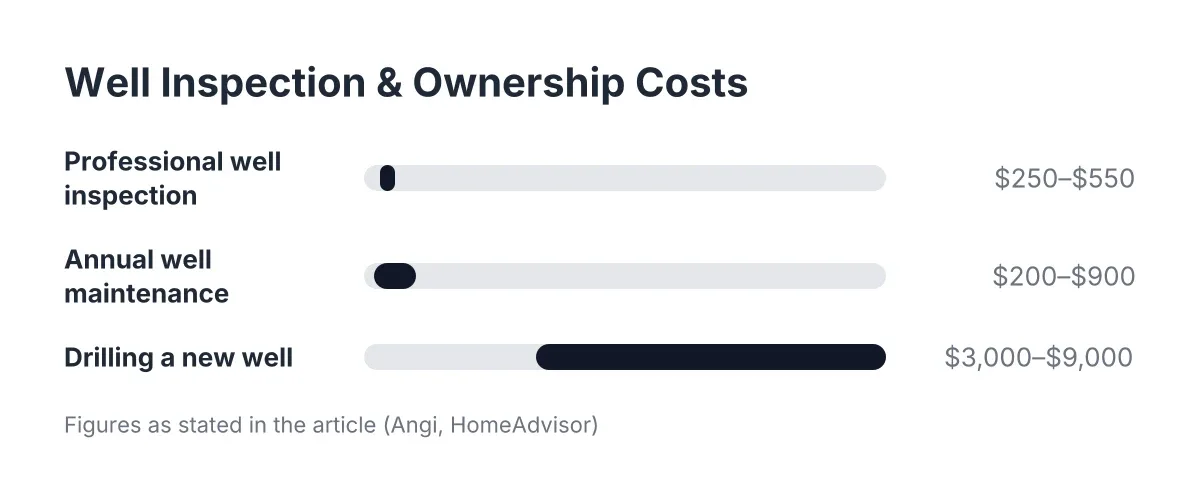
A typical professional well inspection costs $250 to $550 according to Angi, though scope significantly changes this. A flow test and lab work cost more than visual checks but are worth every dollar during purchase. Read our full guide to well inspection cost before booking.
Why Water Well Inspection Matters Before You Buy
Buying a home on a well means buying infrastructure the seller may know nothing about. Unlike a furnace or a roof, most of the system sits hundreds of feet underground where nobody can see it. As a result, the inspection report is often the only honest documentation the well will ever have.
The escrow clock is the real constraint
Real estate deadlines drive everything here. Most Oregon purchase agreements give you a ten business day inspection period, and lab results for bacteria and arsenic take several days on their own. This means you need to schedule the well inspection early, ideally the same week your offer is accepted. Waiting until day six leaves no room to negotiate repairs, ask for a price reduction, or walk away with your earnest money intact.
Oregon law also puts water testing on the seller's side of the table. Under the state's Domestic Well Testing Act, sellers of properties with wells must test for total coliform bacteria, nitrates, and arsenic and report the results. The Oregon Health Authority's Domestic Well Safety Program explains the requirements in detail. That said, the seller's test covers water quality only. It says nothing about the pump, the pressure tank, the flow rate, or the well's remaining life. Your inspection fills that gap.
Neutral documentation beats sales pressure
Here is the part most buyers never think about. If the company inspecting your well also wants to sell you a new one, the incentives get murky fast. A pre-purchase inspection should produce a documented, neutral report: measurements, photos, lab results, and a clear statement of what works and what does not. You and your agent can then negotiate from evidence rather than from someone's opinion.
For context on what failure costs, homeowners spend an average of $3,000 to $9,000 to drill a well, with an average around $5,500, according to HomeAdvisor. Consequently, a few hundred dollars spent on inspection is the cheapest insurance in the entire transaction. If the well is nearing the end of its life, you want that reflected in the purchase price, not discovered the first dry August after you move in.
Reading the Report: Well Age, Depth, and What the Numbers Mean
The report only helps you if you can interpret it. Most well and pump inspection reports follow a similar structure, so knowing what each section means puts you ahead of nearly every buyer and most agents.
How old is this well, really?
Start with the well log. Oregon's Water Resources Department archives well reports going back decades, and the log tells you the drill date, total depth, casing depth, and the yield the driller recorded at completion. If no log exists, the well likely predates modern reporting, which usually means it is fifty years old or more. Age alone does not condemn a well. However, it changes how you read everything else in the report, because older wells often have shallower casings and seals built to outdated standards.
Depth and static water level matter together. A 300-foot well with water standing at 40 feet has enormous reserve. Conversely, a 90-foot well with water at 70 feet has almost none, and a dry summer can expose that quickly. Oregon tracks aquifer conditions closely; the state's Groundwater Hydrology Section maintains more than 400 observation wells and measures over 1,200 more, according to the Oregon Water Resources Department. In parts of east Multnomah and Clackamas County, those long-term trends matter, and a good inspector will frame your well's numbers against local conditions.
Red flags versus normal wear
Some findings are routine maintenance. For example, a waterlogged pressure tank, a worn pressure switch, or a cracked well cap are inexpensive fixes and normal for a system's age. Other findings deserve harder negotiation: a flow test well below household demand, coliform bacteria that persists after shock chlorination, casing corrosion, or a pump drawing high amperage near the end of its service life.
With this in mind, ask your inspector to separate the report into "fix now," "budget for soon," and "monitor" categories. That structure turns a technical document into a negotiation tool. It also gives you a maintenance roadmap for your first years of ownership, because a water well inspection is not only a transaction event. Repeating one every few years, paired with annual water testing, is how you catch a declining pump before it strands you without water. More than 43 million Americans rely on private wells, according to the National Ground Water Association, and the ones who avoid emergencies are the ones who inspect on a schedule rather than after a failure.
Ready to Get Started?
If you are in escrow on a well property anywhere around Gresham, Sandy, Boring, Damascus, Estacada, Corbett, or Oregon City, get the inspection scheduled before your deadline gets tight. We deliver a documented, neutral well and pump inspection report built for real estate timelines, so you and your agent get proof instead of a sales pitch. Call us and we will walk you through the scope, the cost, and how fast we can get your results back.