Well Pump Installation — Complete Guide
Buying land in Gresham, Sandy, Boring, or Damascus usually means buying a private well, and that well needs the right pump before you can build. Well pump installation covers more than dropping a pump down a casing. It means matching pump type and horsepower to your well depth, sizing the system for your household's real water demand, and installing everything to Oregon code. This guide walks you through pump options, sizing math, and the installation process itself, so you know what a properly built system looks like before you sign off on one. Along the way, we link to deeper resources on cost and our local installation service.
What You'll Find in This Guide
Jet Pump vs Submersible Pump: Which One Fits Your Well?
The first decision in any pump installation is the pump type. In practice, that decision is mostly made for you by one number: the depth to water in your well. Everything else follows from it.
A jet pump sits above ground, usually in a well house or basement, and pulls water up by suction. Shallow-well jet pumps work when the water level sits within about 25 feet of the surface. Deep-well jet pumps extend that reach with a second pipe, but they lose efficiency fast as depth increases. As a result, jet pumps make sense mainly on shallow wells near the valley floor, where the water table sits high.
A submersible pump works the other way around. It hangs down inside the well casing, fully submerged, and pushes water up rather than pulling it. Because pushing water is far more efficient than pulling it, submersibles handle deep wells without strain. They also run quieter, last longer in most conditions, and stay protected from freezing because the pump body sits below ground.
Why Most Gresham-Area Wells Get Submersible Pump Installation
Around here, the answer is usually a submersible. Wells on the rural edge of Clackamas and Multnomah County, out toward Boring, Estacada, and Corbett, often reach well past the practical limit of a jet pump. The foothill geology pushes drillers deeper to find reliable water, and a jet pump simply cannot lift from those depths. However, if you bought a property with an older shallow well and an existing jet pump that still meets your needs, replacing like for like can be the cheaper move.
That said, pump type is only part of the price question. Depth, wire and pipe runs, and the condition of your pressure tank all matter more than the pump's sticker price. Our guide to well pump installation cost walks through those variables in detail. For context, Angi reports a national average well pump replacement cost of $1,898, with most homeowners paying between $975 and $2,821. Deep submersible installs on new construction typically land above that midpoint, and shallow jet pump swaps land below it.
How to Size a Well Pump for Your Depth and Household Demand
Sizing is where generic advice fails Gresham-area buyers. Manufacturer charts assume average conditions, but your well is not average. It has a specific depth, a specific static water level, and a specific yield in gallons per minute. Additionally, your future house has a specific demand profile. A proper sizing job starts with those numbers, not with a horsepower rating pulled off a shelf.
Start With Household Demand
First, count your fixtures. A common rule of thumb assigns one gallon per minute of demand to each fixture: every faucet, shower, toilet, and appliance that uses water. For example, a typical three-bedroom, two-bath home lands somewhere around 8 to 12 GPM of peak demand. Planning irrigation, livestock, or a shop with a hose bib? Add that on top. Undersizing here is the classic mistake on new construction, because the pump gets specced before the site plan is finished.
Then Match the Well's Reality
Next, compare that demand to what the well can actually produce. Your well's yield, recorded on its well log, sets the ceiling. If the well produces 15 GPM, a 12 GPM pump works fine. However, if the well only yields 5 GPM, installing a 12 GPM pump will pump the well dry and burn out the motor. In that case, the right design uses a smaller pump paired with more storage, so the system banks water during low-demand hours.
Depth drives horsepower. A pump lifting water 400 feet works much harder than one lifting 100 feet, so deeper wells in the Sandy and Estacada foothills often call for 1 to 1.5 horsepower motors where a shallow valley well might need only half a horse. If you have not drilled yet, you can research nearby well depths through the Oregon Water Resources Department well log database, which archives logs for existing wells across the state. This means you can estimate depth, yield, and likely pump requirements before you ever break ground.
Finally, resist the urge to oversize. A pump that is too big short-cycles, wears out its motor, and can outrun the well. Right-sized beats bigger every time.
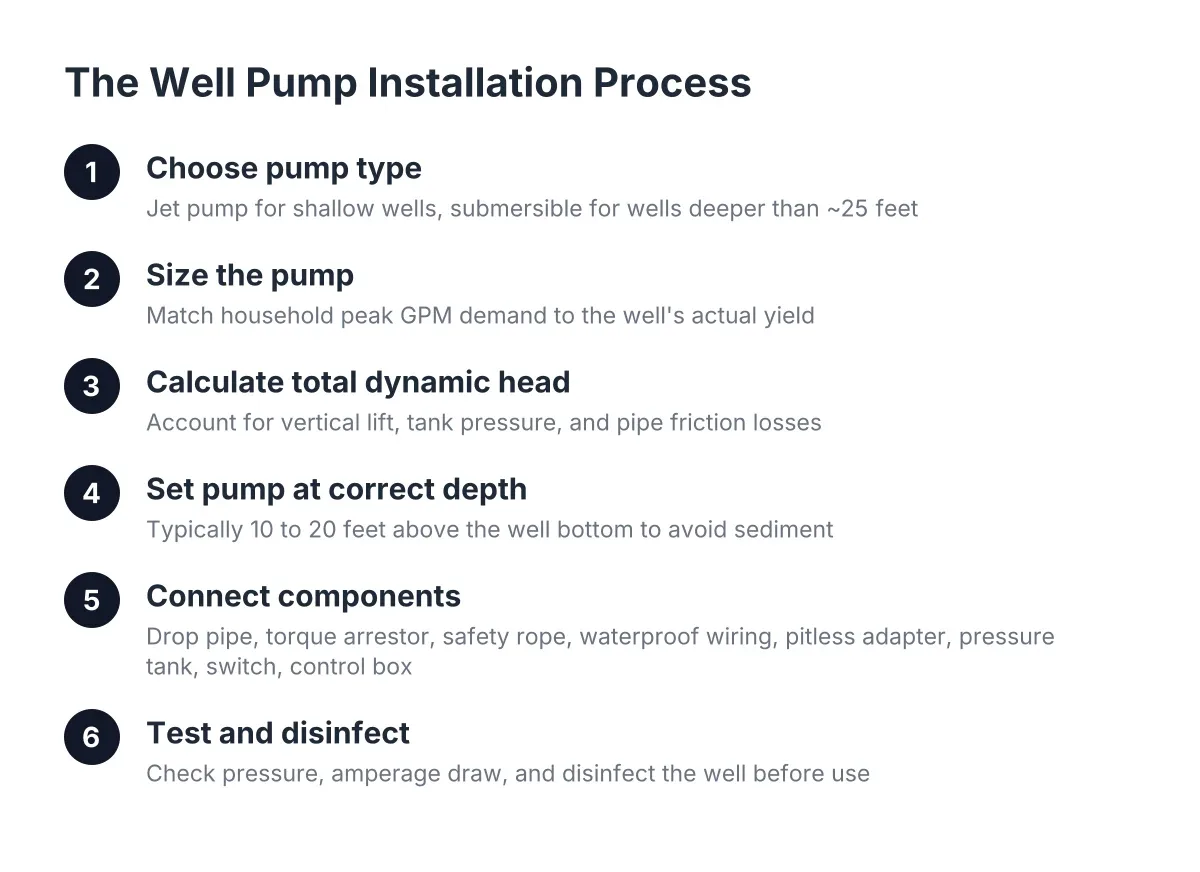
What the Well Pump Installation Process Actually Involves
A pump system is more than the pump. To put it simply, you are buying a complete water delivery system: pump, drop pipe, wiring, pitless adapter, pressure tank, pressure switch, and controls. Understanding how the pieces go in helps you judge whether an installer is doing the job right.
From Assessment to Water at the Tap
Every good installation starts with an assessment. On a new well, the installer reviews the well log for depth, static water level, and tested yield. On a replacement, they also pull the old pump and inspect the drop pipe and wiring for wear. With this in mind, they select the pump model, set the installation depth, and spec the wire gauge for the run length.
For a submersible, the crew assembles the pump, motor, drop pipe, and wire at the surface, then lowers the whole string down the casing to the planned depth. The pump connects to your home's water line through a pitless adapter, a fitting that passes through the casing below the frost line. Because the connection sits underground, the system resists freezing without a well house. Above ground, the crew sets or reuses the pressure tank, wires the pressure switch and any control box, and bonds the electrical to code.
Then comes the part too many installers skip: testing. A proper startup includes checking the pressure switch cut-in and cut-out settings, verifying the tank's air precharge, measuring amperage draw on the motor, and running the system long enough to confirm steady pressure. Beyond that, new construction installs in Oregon must follow state well construction standards, and the electrical work needs to meet code for permitting and final inspection on your build.
What Changes for New Construction
If you are building, timing matters. The well typically gets drilled early, but the permanent pump system often waits until power reaches the site. Meanwhile, your builder may run a temporary setup for construction water. Coordinating those phases avoids paying twice. Our water well pump installation service in Gresham handles both phases for new builds across the east metro, and we size the permanent system off your actual well log rather than a generic chart. For budgeting the full picture, keep drilling costs in mind too. HomeAdvisor puts the average cost to drill a well at $5,500, with most projects running $3,000 to $9,000, and the pump system is a separate line item on top of that.
Ready to Get Started?
If you are planning a build on well water anywhere around Gresham, Sandy, Boring, Damascus, Estacada, or Corbett, get the pump system designed from your well's real numbers, not a guess. We install and size pump systems every week on the exact geology you are building on, and we will give you a straight answer on what your well needs and what it will cost. Call us and tell us about your property, and we will take it from there.