Well Pump Repair — Complete Guide
Your well pump failed, your taps are dry, and you need answers fast. This guide covers well pump repair for Gresham-area homeowners: the symptoms that reveal what broke, the causes behind most failures, and what a fix should actually cost. You will learn how to tell a $30 pressure switch problem from a full pump replacement before anyone quotes you a price. By the end, you will know what is likely wrong with your system and how to choose a repair option you can trust.
What You'll Find in This Guide
Prefer to have a pro handle it? Well Pump Repair is one call away.
Well Pump Troubleshooting: What Your Symptoms Are Telling You
Before you call anyone, pay attention to what your system is doing. The symptoms point to the cause more often than most homeowners expect. A pump that quit entirely tells a different story than one that runs constantly or delivers sputtering water.
Start with the simplest check: power. A tripped breaker or a failed pressure switch causes a surprising share of "dead pump" calls. If the breaker trips again immediately after you reset it, stop. That usually signals a shorted motor or damaged wiring, and repeated resets can make the damage worse.
Next, listen. A well pump making noise then quitting often points to a motor drawing too much current before its thermal overload shuts it down. Rapid clicking near the pressure tank suggests short cycling, which usually means a waterlogged tank rather than a bad pump. However, grinding or rattling from the wellhead can mean the pump is running dry or wearing out its bearings.
Then watch your water. Sputtering faucets and air in the lines suggest a dropping water level or a leak in the drop pipe. Cloudy or sandy water can mean the pump has sunk toward the bottom of the well or the well screen is failing. Meanwhile, weak pressure that fades through the day often traces back to a failing pump slowly losing capacity, not a sudden break.
Why Well Pump Repair Symptoms Matter for Price
Each symptom maps to a very different repair bill. For example, a pressure switch swap is one of the cheapest fixes in the entire system. A burned-out submersible motor at 300 feet is one of the most expensive. That gap is exactly why we wrote our well pump repair cost guide, which walks through what each failure typically runs. With this in mind, describe your symptoms precisely when you call any contractor. A company that quotes a full replacement without asking what the system was doing has not earned your trust yet.
What Causes Well Pumps to Fail in the East Portland Metro
Well pumps do not fail randomly. In our service area, from Gresham out through Sandy, Boring, Damascus, Estacada, Corbett, and Oregon City, a handful of causes account for nearly every no-water call we run.
Age leads the list. Most submersible pumps last 10 to 15 years, and jet pumps often less. If your pump is past that window, a failure is not a surprise. It is a scheduled event that finally arrived. Additionally, many rural properties out here still run pumps installed when the house was built, so plenty of systems are living on borrowed time.
Electrical problems come next. Lightning, utility surges, and corroded wiring splices all kill pump motors. Because the wiring runs down the well casing in wet conditions, a small insulation failure grows until the motor shorts. Similarly, a failing capacitor or control box can mimic a dead pump, and replacing that component costs a fraction of pulling the pump.
Sediment and water chemistry matter too. Wells on the Clackamas and Multnomah County rural edge draw from aquifers that vary block by block. Some produce clean water for decades. Others carry fine sediment that grinds through impellers and clogs screens. As a result, two neighbors with identical pumps can see wildly different lifespans.
Dry Running and Dropping Water Levels
Finally, low water levels destroy pumps fast. A pump that runs dry overheats within minutes. During late-summer dry spells, shallower wells in our area can drop below the pump intake, especially with heavy irrigation use. If your no-water problems started in August, the well itself may be the issue rather than the pump. The U.S. EPA's private well resources offer useful background on how private wells work and why owners carry full responsibility for maintaining them. In practice, a proper diagnosis checks the water level before condemning the pump, which is exactly how we approach well pump repair in Gresham.
Well Pump Repair vs. Replacement: How the Decision Gets Made
Once you know what failed, the real question is whether to repair or replace. The honest answer depends on three factors: the age of the pump, the cost of pulling it, and what else in the system is near the end of its life.
Repair makes sense when the failure sits above ground. Pressure switches, pressure tanks, control boxes, and capacitors are all accessible without pulling the pump. Consequently, these fixes cost less and happen fast, often the same day. If your pump is under ten years old and the failure is a surface component, repair is almost always the right call.
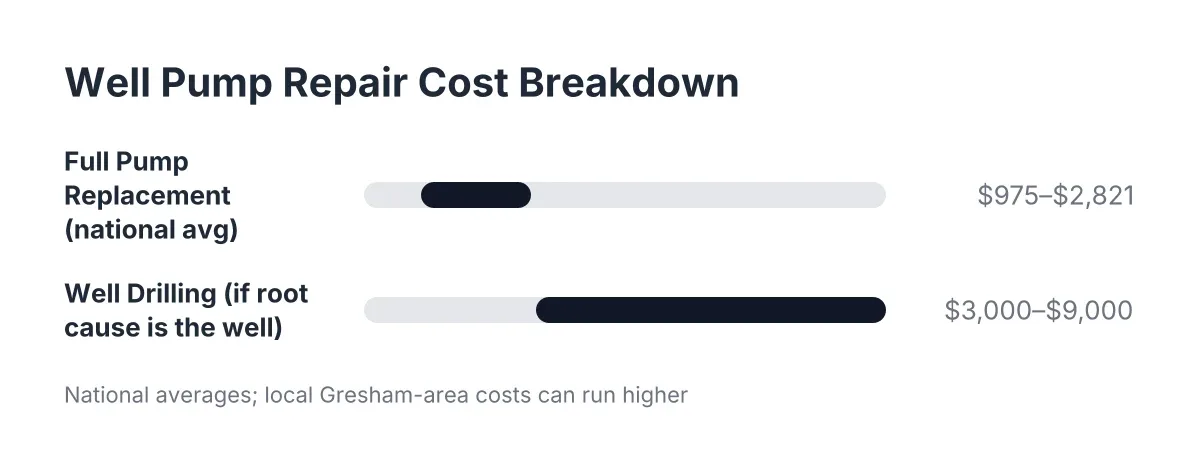
Replacement makes sense when the pump or motor itself fails, especially in a deep well. Pulling a submersible pump from several hundred feet takes equipment, labor, and time. Because the labor cost is the same whether you repair or replace, putting an old pump back down the hole rarely pays off. According to Angi, the national average well pump replacement cost is $1,898, with most homeowners paying between $975 and $2,821. Deep wells and higher-horsepower pumps land at the top of that range, and our cost guide breaks down where your well likely falls.
Questions to Ask Before You Approve Any Work
That said, price alone should not drive the decision. Ask any contractor these questions before you sign off. What exactly failed, and how did you confirm it? What is the static water level in my well? Will the replacement pump match my well's depth and recovery rate? A specialist answers these easily. A generalist plumber often cannot, because well work sits outside their daily trade.
Beyond that, consider a broader checkup while the truck is already on site. A professional well inspection typically costs $250 to $550, according to Angi, and it can catch a failing pressure tank or degraded wiring before either one strands you without water again. To put it simply, the cheapest repair is the one you never need.
How to Handle a No-Water Emergency the Right Way
When the water stops, panic pushes people toward bad decisions. Instead, work through a short sequence before you call anyone. It takes ten minutes and can save you hundreds of dollars.
First, check the breaker panel. Reset a tripped breaker once, and only once. Second, look at the pressure gauge near your tank. A reading near zero with the pump running points to a pump or piping problem. Meanwhile, normal pressure with no water at the taps suggests a plumbing issue inside the house, not the well. Third, tap the pressure switch housing gently. Sometimes corroded contacts stick, and the pump kicks on. That is a temporary fix, but it buys you water for the night.
If none of that restores water, you need a professional. However, who you call matters. Searching for emergency well pump repair near me returns a mix of true well specialists, general plumbers, and lead-generation sites that sell your phone number to whoever pays. A plumber can handle your pressure tank. Few plumbers own the hoist equipment to pull a submersible pump from 250 feet, and fewer still stock pumps sized for local well depths.
What a Good Emergency Call Looks Like
A trustworthy emergency response follows a pattern. The company asks about your symptoms on the phone. They give you a realistic arrival window instead of a vague promise. On site, they test the electrical supply, the pressure switch, and the water level before touching the pump. Most importantly, they quote the full cost before starting work, not after your pump is lying on the lawn. That is the standard we hold ourselves to on every well pump repair call in Gresham, and it is the standard you should demand from anyone who shows up at your wellhead. As a result, you stay in control of the decision even in the middle of an emergency.
Ready to Get Started?
If your well pump stopped working and you need water back today, we can help. We diagnose on site, explain exactly what failed, and quote the full cost before any work begins. Call us now and tell us what your system is doing, and we will tell you what it likely means before we ever roll a truck.