Well Repair Costs — Complete Guide
If you own a home or rental property on a private well around Gresham, Sandy, Boring, or Damascus, a well failure raises two urgent questions: what broke, and what should fixing it cost? This guide breaks down well repair pricing for east Multnomah and Clackamas County properties, from a well pump replacement cost that runs into the thousands to a simple pressure switch swap that costs a fraction of that. You will learn what drives the price of each common repair, how to read an estimate line by line, and how to tell a fair quote from an inflated one. That matters most when you manage the property from a distance and cannot stand at the wellhead while a contractor explains the problem. Use this page as your starting point, then follow the linked guides for deeper numbers on each repair type.
What You'll Find in This Guide
What Drives Well Pump Replacement Cost on Oregon Wells
Most well repair calls in the Gresham area end at the pump. Pressure tanks fail, wiring corrodes, and pitless adapters leak, but the submersible pump does the hardest work and wears out first. As a result, the pump is where most of your repair budget goes, and it is where pricing varies the most.
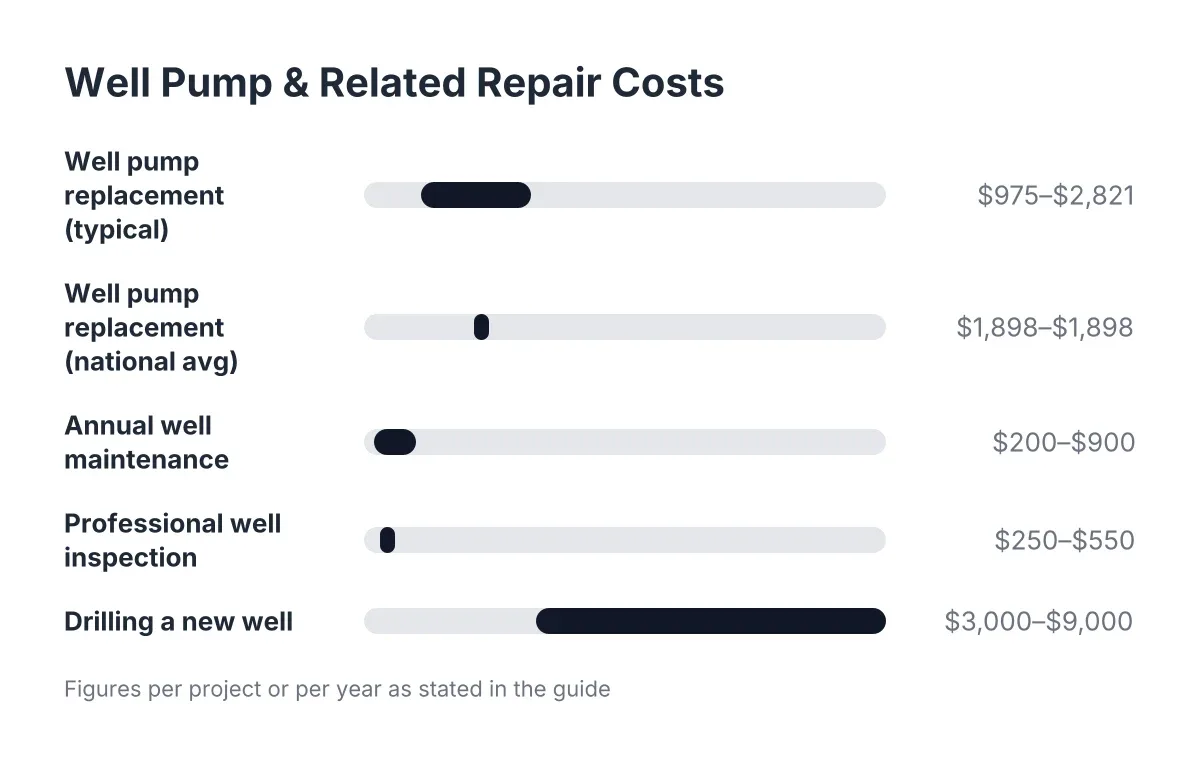
According to Angi, the national average well pump replacement cost is $1,898, with most homeowners paying between $975 and $2,821. That range is wide for a reason. A shallow-well jet pump sitting in a pump house costs far less to replace than a submersible pump hanging 300 feet down a drilled well. Around here, depth is the swing factor. Wells on the flat ground near Gresham and Troutdale often run shallower, while properties up toward Corbett, Estacada, and the Cascade foothills can sit on wells drilled deep to reach reliable water.
Depth changes the price in three ways. First, a deeper well needs a higher-horsepower pump, and pump price climbs with horsepower. Second, every foot of depth adds drop pipe and wire, which you pay for by the foot. Third, pulling a pump from 400 feet takes a pump hoist and more crew time than pulling one from 80 feet. Our guide on how much well repair costs walks through these depth tiers with real numbers.
Why the Cheapest Pump Quote Often Costs More Later
A low quote sometimes means a builder-grade pump with a short warranty. In practice, a quality submersible pump on a properly sized system should run 10 to 15 years in local conditions. However, an undersized or bargain pump can fail in half that time, and you pay the pull-and-set labor all over again. For a rental property, that second failure also means another round of tenant calls, water outages, and scheduling headaches from wherever you live.
With this in mind, ask any contractor to name the pump brand and model on the quote. Then ask for the warranty terms in writing. A fair well pump replacement cost buys you a matched pump, correct wire gauge, new fittings, and a company that will answer the phone if something goes wrong in year three.
How to Read a Well Pump Replacement Cost Estimate Line by Line
An itemized estimate is your best protection against overpaying, especially when you cannot inspect the work yourself. A vague quote that says "well repair: $3,200" tells you nothing. In contrast, a fair contractor breaks the number into parts, labor, and equipment time so you can check each line.
Here is what a complete pump and well repair estimate should show. Expect a line for the diagnosis or service call, one for the pump or failed component with brand and model, one for drop pipe and wire by the foot, one for fittings and a new check valve, and one for pull-and-set labor. Additionally, look for a line covering disinfection of the well after the work, since opening the system introduces bacteria risk. If the estimate lumps all of that into a single number, ask the contractor to break it out. A legitimate company can do that in minutes.
Red Flags That Suggest an Inflated Quote
Certain patterns show up again and again in overpriced quotes. Watch for a contractor who diagnoses a dead pump over the phone without checking the pressure switch, the tank, or the wiring first. Those cheaper components cause a large share of "no water" calls, and replacing a $60 switch beats replacing a $1,500 pump. Similarly, be wary of anyone who cannot tell you your well depth. Oregon keeps drilling records on file, and you can look up your property's original well log through the Oregon Water Resources Department before you get a single quote. Knowing your depth in advance takes away the biggest lever a bad actor uses to pad an estimate.
Beyond that, compare the parts pricing against known baselines. Our well repair cost guide lists typical ranges by failure type, so you can spot a line item that runs double the going rate. For example, if a quote prices a standard pressure tank at four times retail, ask why. A fair contractor explains markup without getting defensive. That conversation alone tells you a lot about who you are hiring.
When Repair Stops Making Sense: Repair vs. Re-Drill Math
Sometimes the honest answer is that your well, not your pump, is the problem. A well that produces less water each year, pumps sand, or keeps failing water tests may be reaching the end of its useful life. In that case, pouring repair money into it is the expensive choice, even though each individual repair looks cheaper than drilling.
The math works like this. According to HomeAdvisor, homeowners spend an average of $3,000 to $9,000 to drill a well, with an average price around $5,500, and most wells need drilling or re-drilling every 10 to 20 years. Forbes puts the average at $5,625, which lines up closely. On a per-foot basis, Angi reports drilling costs of $25 to $65 per foot, with $25 to $35 per foot typical for most residential projects. Consequently, if you face a $2,500 pump replacement on a 40-year-old well with declining yield, you may only be a couple of repairs away from the cost of a new well that solves the problem for decades.
How to Make the Call From a Distance
If you manage the property remotely, you need data instead of a gut feeling. Start with a professional well inspection, which Angi pegs at a typical $250 to $550. That inspection should document static water level, recovery rate, pump amperage draw, and water quality. Then compare those findings against the well's age and repair history. A well with strong recovery and clean water justifies the repair. However, a well with falling yield and repeated sediment problems tells you to price a new one before spending more on the old one.
Ask for the inspection report in writing with photos. This gives you a record you can review from anywhere, share with a second contractor for comparison, and keep on file for the next tenant turnover or a future sale. To put it simply, a few hundred dollars of documented inspection can save you from a few thousand dollars of repairs on a well that was never going to recover.
Local Factors That Move Well Repair Prices Around Gresham
National averages give you a starting point, but east Portland metro conditions push prices up or down in predictable ways. Understanding these local factors helps you judge whether a quote reflects real conditions or padding.
Access matters more out here than the national numbers suggest. Properties along the Sandy River corridor, up the hills near Corbett, or down long gravel drives in Boring and Estacada can be hard to reach with a pump hoist truck. If the wellhead sits behind a fence, under a deck, or inside an old pump house, the crew spends time on access before touching the well. Therefore, a quote that includes an access or setup line is not automatically inflated. It may reflect the reality of your site. That said, the contractor should explain the charge in plain terms, and it should scale with the actual difficulty.
Seasonality plays a role too. Winter storms knock out power across the rural edge of Clackamas and Multnomah counties, and a power surge when the grid comes back can kill a pump or fry a control box. As a result, emergency calls cluster after storms, and after-hours rates apply. If you own rentals, this is worth planning around. A pre-winter inspection catches weak components before they fail at the worst possible time, which matters when your tenant is the one without water and you are three time zones away.
Budgeting for Ownership, Not Just This Repair
Angi reports that ongoing well maintenance costs homeowners $200 to $900 per year. For a rental property owner, treating that as a line item in your annual budget beats treating every failure as a surprise. In practice, that budget covers a periodic inspection, water testing, and small component replacements. It also builds the paper trail that keeps a future well pump replacement cost from arriving as a shock. Owners who track their system's history negotiate repairs from a position of knowledge, and contractors quote them straighter numbers because of it.
Ready to Get Started?
If your well or pump is acting up, or you just want a straight answer on what a repair should cost, we are a Gresham-based water well specialist serving Sandy, Boring, Damascus, Estacada, Corbett, and Oregon City. Call us and we will talk through your symptoms, pull your well log, and give you an itemized estimate you can check line by line, whether you live at the property or manage it from across the country. No guesswork, no vague lump sums, just clear pricing from people who work these wells every week.