Well Water Testing — Complete Guide
If your home runs on a private well, you are the water utility, and well water testing is the only way to know what you are actually drinking. A store-bought well water testing kit can give you a quick read on a few basics, but it cannot tell you whether your water meets health standards, satisfies an Oregon real estate transaction, or explains that odd taste or stain. This guide covers what a proper test checks for, how often you should test, what results mean in plain language, and what to do when something comes back high. You will also find links to our deeper articles on cost and logistics, all written from the perspective of a Gresham well contractor who can fix what the lab finds.
What You'll Find in This Guide
What a Well Water Test Actually Checks For
A well water test is not one test—it's a menu. What you order depends on why you're testing. Most homeowners start with the core health panel, then add parameters based on location, well construction, and what their water looks, smells, or tastes like.
The three contaminants that matter most in Oregon are total coliform bacteria, nitrate, and arsenic. Coliform bacteria signal that surface water or septic contamination is reaching your well. Nitrate comes from fertilizer, livestock, and failing septic systems, posing real risk to infants. Arsenic occurs naturally in some Pacific Northwest bedrock, so a well can produce it even with perfect construction. These three are the exact parameters Oregon requires sellers to test when a property with a well changes hands.
Beyond that core panel, broader tests check for iron, manganese, hardness, pH, lead, copper, sodium, and total dissolved solids. Orange staining on fixtures usually points to iron; blue-green stains suggest corrosive water pulling copper from pipes. A rotten-egg smell typically means hydrogen sulfide or sulfur bacteria. These secondary parameters rarely threaten health, but they reveal much about your plumbing, pump, and whether you need treatment.
The stakes are higher than most well owners assume. A USGS study of 2,100 private wells found that about one in five contained at least one contaminant above a human-health benchmark. Since more than 23 million U.S. households rely on private wells, roughly one in five neighbors on wells could be drinking water that would fail a health standard—yet most don't know because contaminated water often looks and tastes fine.
Cost scales with how many parameters you test. Test smart rather than test everything. Our guide to how much well water testing costs walks through which panels make sense for which situations, so you don't pay for unnecessary analysis.
Home Well Water Testing Kits vs. Certified Lab Analysis
Hardware stores and online retailers sell dozens of test kits, and they range from useful screening tools to near-useless strips. Understanding what a well water testing kit can and cannot do saves you money and prevents a false sense of security.
What a Home Well Water Testing Kit Does Well
A home kit works fine as a screening tool for aesthetic parameters. For instance, strips that measure hardness, pH, iron, and chlorine give you a reasonable ballpark, and they cost very little. If you are trying to size a water softener or figure out why your fixtures stain, a kit gives you a starting point the same day. Additionally, some mail-in kits send your sample to a real laboratory, which puts them a step above test strips in accuracy.
Where Kits Fall Short
However, a well water testing kit has hard limits. Bacteria strips and vial tests produce false negatives and false positives at rates no health authority would accept. Kits cannot detect arsenic or lead at the low concentrations that actually matter for health. Most importantly, no home kit result counts for anything official. Lenders, buyers, and Oregon's real estate testing requirements all demand analysis from an accredited laboratory with a documented chain of custody. To put it simply, a kit can raise a question, but only a certified lab can answer it.
Sampling technique matters as much as the analysis. A bacteria sample collected from a garden hose, an unsanitized faucet, or a tap with an aerator still attached will often test positive even when the well is clean. This means that a do-it-yourself sample can send you chasing a contamination problem that does not exist. A professional pulls the sample from the right tap, sanitizes the fixture, and gets the bottle to the lab within the required hold time. When we test a well, we also look at the wellhead itself, because a cracked cap or a low casing explains more coliform hits than anything happening underground.
Use a kit for curiosity. Use a certified lab for health decisions, transactions, and anything you might act on with real money.
How Often to Test, and What Oregon Requires for Home Sales
Testing frequency is where most well owners fall behind. The well works, the water tastes fine, and years slip by without a single lab result. That said, groundwater conditions change, well components age, and a well that tested clean five years ago is not guaranteed clean today.
The Routine Testing Schedule
Test for total coliform bacteria and nitrate every year. These two parameters shift the fastest, and they respond to things you cannot see, like a neighbor's new septic system or a wet winter pushing surface water toward your casing. Every three to five years, run a broader panel that includes arsenic, lead, and the aesthetic parameters. Beyond the calendar, certain events should trigger an immediate test: a flood near the wellhead, any well or pump repair that opened the system, a change in taste, odor, or color, a new baby in the house, or a septic repair on your property or next door. Oregon's aquifers are actively monitored, and according to the Oregon Water Resources Department, the state maintains more than 400 observation wells and measures more than 1,200 additional wells to track groundwater conditions. Conditions genuinely change year to year, and your well is not exempt.
Testing for a Real Estate Transaction
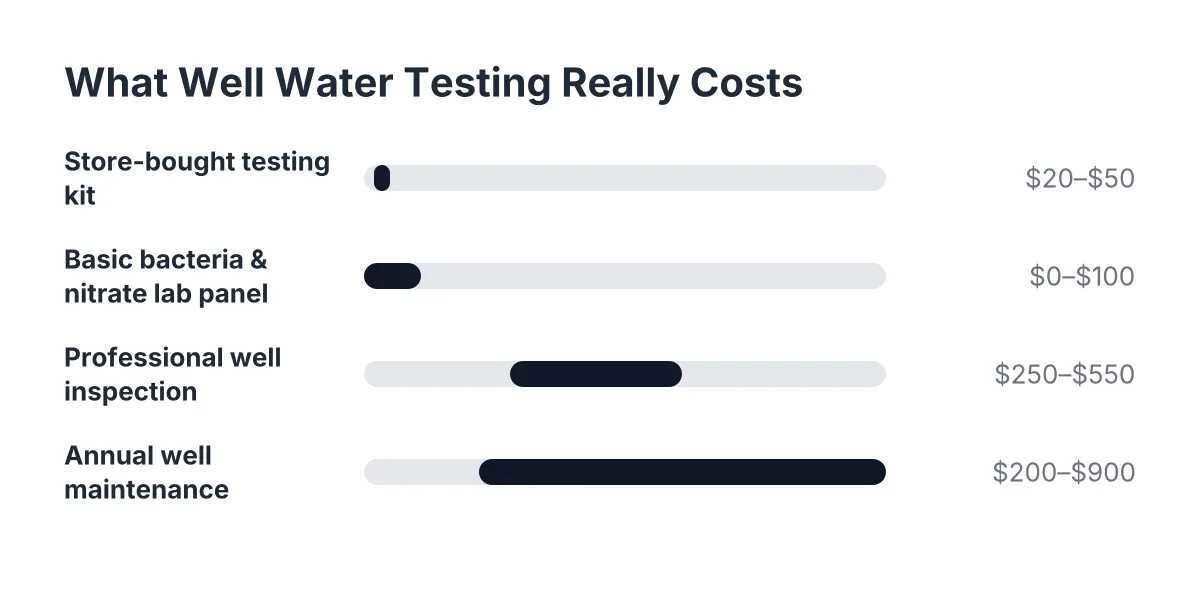
Selling a home with a well in Oregon triggers a legal requirement. Under the state's Domestic Well Testing Act, the seller must test the well for total coliform bacteria, nitrate, and arsenic, and must submit the results to the Oregon Health Authority within 90 days of receiving them. Buyers should read those results carefully, and many buyers order their own expanded testing during inspection anyway. For buyers, pairing the water test with a full well inspection makes sense, since the water quality and the condition of the pump, pressure tank, and casing are separate questions. According to Angi, a typical professional well inspection costs $250 to $550, which is a small line item next to the cost of discovering a failing well after closing. Our well water testing cost guide breaks down what transaction testing runs in the Gresham and east Portland metro area.
Timing matters in a transaction. Consequently, order the test early in the process, because a positive coliform result usually means shocking the well, flushing, and retesting before you can hand over a clean report.
What to Do When a Test Comes Back Bad
A failed test is solvable—the fix depends on which parameter failed. A driller offers a plan; a lab offers numbers.
Coliform bacteria is the most common failure. Inspect the wellhead for a missing cap gasket, unsealed conduit hole, or low casing. Repair the entry point, shock-chlorinate, flush, and retest. If bacteria return, consider a sanitary seal, continuous UV disinfection, or replacement well. E. coli is more serious than coliform—stop drinking and switch to bottled water until you retest clean.
Nitrate and arsenic cannot be disinfected away; they require treatment equipment. Reverse osmosis at the kitchen tap handles most households. A deeper well into a cleaner aquifer often makes more sense long-term, especially when nitrate indicates shallow contamination. A driller familiar with your local geology can guide this decision honestly.
Aesthetic failures—iron, manganese, hardness—affect comfort and plumbing protection, not health. Filtration and softening solve them. Always size treatment equipment from a certified lab result, not a testing kit reading, which lacks the precision to specify a system. Oversized treatment wastes money monthly.
Keep every lab report. A testing history makes future problems easier to diagnose and becomes a selling point when you list the property.
Ready to Get Started?
If you own a well anywhere around Gresham, Sandy, Boring, Damascus, Estacada, Corbett, or Oregon City, we can test your water, explain the results in plain language, and fix whatever the lab finds. You get one contractor for the sample, the diagnosis, and the repair, whether that means a wellhead fix, a treatment recommendation, or a deeper well. Call us and tell us why you are testing, and we will tell you exactly which panel you need and what it will cost.