Why Residential Well Maintenance Costs Less Than an Emergency Pump Replacement
If you own a well outside Gresham, in Sandy, Boring, Damascus, Estacada, Corbett, or Oregon City, here is the honest math: residential well maintenance costs a few hundred dollars a year, while an emergency pump failure can cost several thousand dollars all at once, usually at the worst possible time. The faucet runs dry on a Saturday morning with a house full of people, and suddenly you are not comparing prices or asking questions. You are just trying to get water back. This guide lays out a maintenance framework built for owners who cannot check on their well every week, so you can plan the small bills on your schedule instead of eating the big one on the well's schedule.
The Real Comparison: Planned Upkeep vs. the No-Water Emergency
Most well owners never think about their well until the water stops. That is understandable. A properly working well is invisible. The pump sits hundreds of feet down the casing, the pressure tank sits in a corner of the garage or crawl space, and water comes out when you open the tap.
However, that invisibility is exactly why the emergency call costs so much more than the maintenance visit. When nothing has been inspected in ten years, the technician who shows up to a no-water call is starting from zero. Is it the pump? The pressure switch? A bad wire down the well? The well itself running low? Every one of those questions takes time to answer, and time on an emergency call is money.
Compare that to a well that gets a routine inspection. The service tech already knows the pump's age, the pressure tank's condition, and how the system behaved last year. When something does fail, the diagnosis is faster and the fix is usually smaller, because the warning signs were caught before the pump burned itself out.
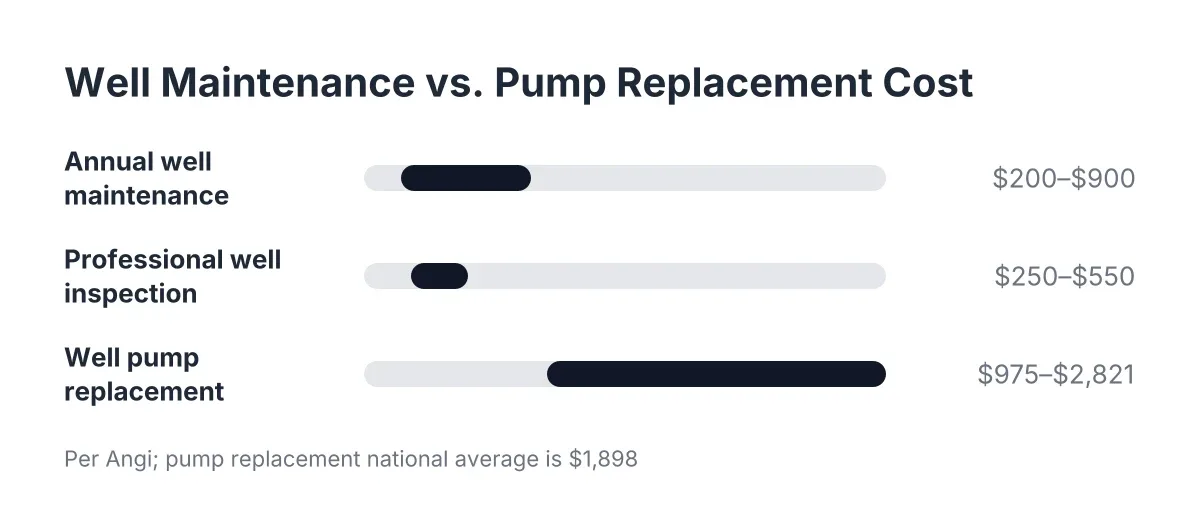
Here is the core trade-off in plain numbers. According to Angi, well maintenance costs homeowners $200 to $900 per year, and a typical professional well inspection runs $250 to $550. Meanwhile, the national average well pump replacement cost is $1,898, with most homeowners paying between $975 and $2,821, also according to Angi. One emergency pump replacement can equal three to five years of routine maintenance, and that figure does not include the days you spend hauling water while you wait.
What Residential Well Maintenance Costs Actually Cover
Residential well maintenance costs typically cover an annual inspection of the pump, pressure tank, wiring, and controls, plus water testing and minor adjustments. Think of it as a physical for the whole system, from the wellhead down to the pump and back up to the pressure tank in your house. The goal is to catch small problems while they are still small.
A thorough well inspection usually includes:
- Checking the wellhead and well cap for cracks, gaps, or damage that could let surface water or pests in
- Testing the pressure tank's air charge and watching how the pump cycles on and off
- Measuring amp draw on the pump motor, which can reveal a motor starting to strain before it fails
- Inspecting the pressure switch, wiring connections, and control box for corrosion or burnt contacts
- Running a water test for bacteria and common contaminants
- Noting flow and recovery behavior so you have a baseline to compare against next year
That baseline matters more than most owners realize. A single inspection tells you how things look today. Two or three years of inspections tell you which direction things are heading. A pump drawing slightly more current each year, or a pressure tank losing its air charge faster each season, is a system telling you it wants attention before it quits.
In addition, routine water well maintenance protects the part of the system nobody can see: the water itself. A cracked well cap or a failing seal can let bacteria into your groundwater supply long before you taste anything wrong. Annual testing catches that quietly, which is a lot better than finding out from a failed test during a home sale.
How a Pump Actually Dies, and Why Waiting Makes It Worse
Most residential systems around the east Portland metro use a submersible pump down in the well paired with a pressure tank in the house, crawl space, or a small pump house, a standard setup described by the Indiana Department of Health. That pairing is the key to pump lifespan. The pressure tank stores water under pressure and supplies small draws on demand, so the pump does not have to kick on every time someone washes their hands. Fewer starts means less wear on the motor.
Here is where neglect gets expensive. When a pressure tank loses its air charge, the pump starts short cycling, turning on and off every few seconds instead of running in longer, healthier stretches. Each start is the hardest moment in a pump motor's life. A failing tank can grind years off a pump that would otherwise have kept working. The tank fix is modest; the pump it kills is not.
The other killer is running dry. A submersible pump is built for heavy use and does not mind running often, but it cools itself with the water moving through it. Let it run with no water passing through, because the well level dropped or a line lost prime, and the pump can burn itself up. Some constant pressure systems include protection that shuts the pump off when the well runs low, which is worth asking about if your well has ever struggled in late summer. Older, basic systems often have no such safeguard.
Watch for these signs your well needs servicing before a full failure:
- Water pressure that drops, surges, or varies from one faucet to another
- The pump clicking on and off rapidly, which you can often hear at the pressure switch
- Air spitting from faucets, a classic sign the well level or the drop pipe has a problem
- A sudden change in water taste, smell, or clarity
- A higher electric bill with no other explanation, since a struggling pump runs longer to do the same work
Any one of these is a maintenance call. All of them, ignored together, are how a no-water Saturday happens.
A Maintenance Framework for Wells You Cannot Watch Daily
A practical well maintenance plan for a property you cannot check often comes down to three layers: one professional inspection a year, a short seasonal walk-around you or a tenant can do in ten minutes, and a written record of everything. This framework works whether you live on the property in Boring or rent out a house on acreage near Estacada that you visit once a month.
Layer one: the annual professional visit
How often should a well be serviced? Once a year is the standard answer for a professional inspection, and that cadence holds for most residential wells in the Gresham area. Book it for the same month every year so it never slips. Late spring works well locally, after the wet season has tested the wellhead seal and before summer puts peak demand on the aquifer.
The annual visit is where the trained eyes go to work: amp readings, pressure tank charge, water testing, and wellhead condition. If your well is 20 years old or more, ask the technician to talk you through the pump's likely remaining life so a future well pump replacement becomes a budgeted line item instead of a surprise.
Layer two: the ten-minute seasonal check
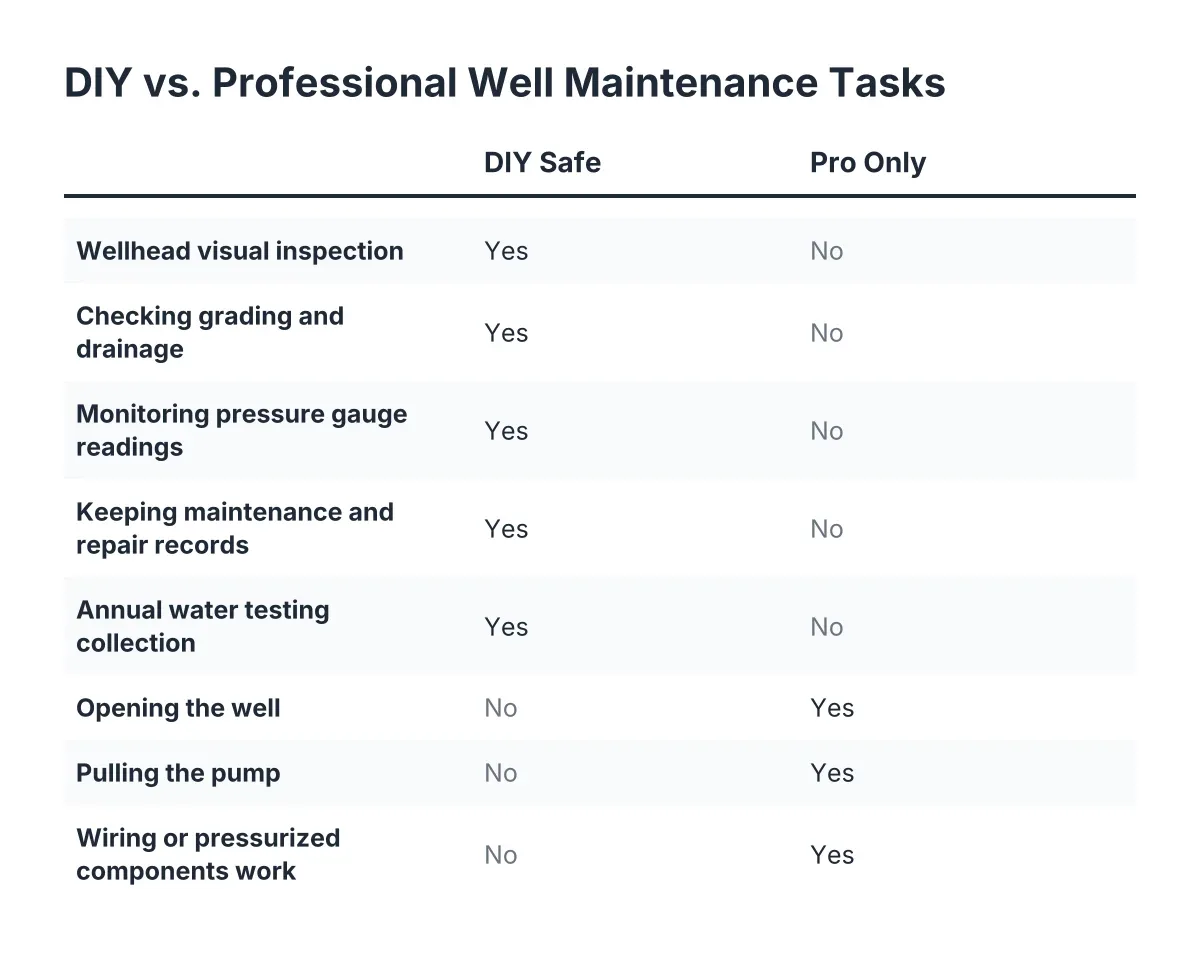
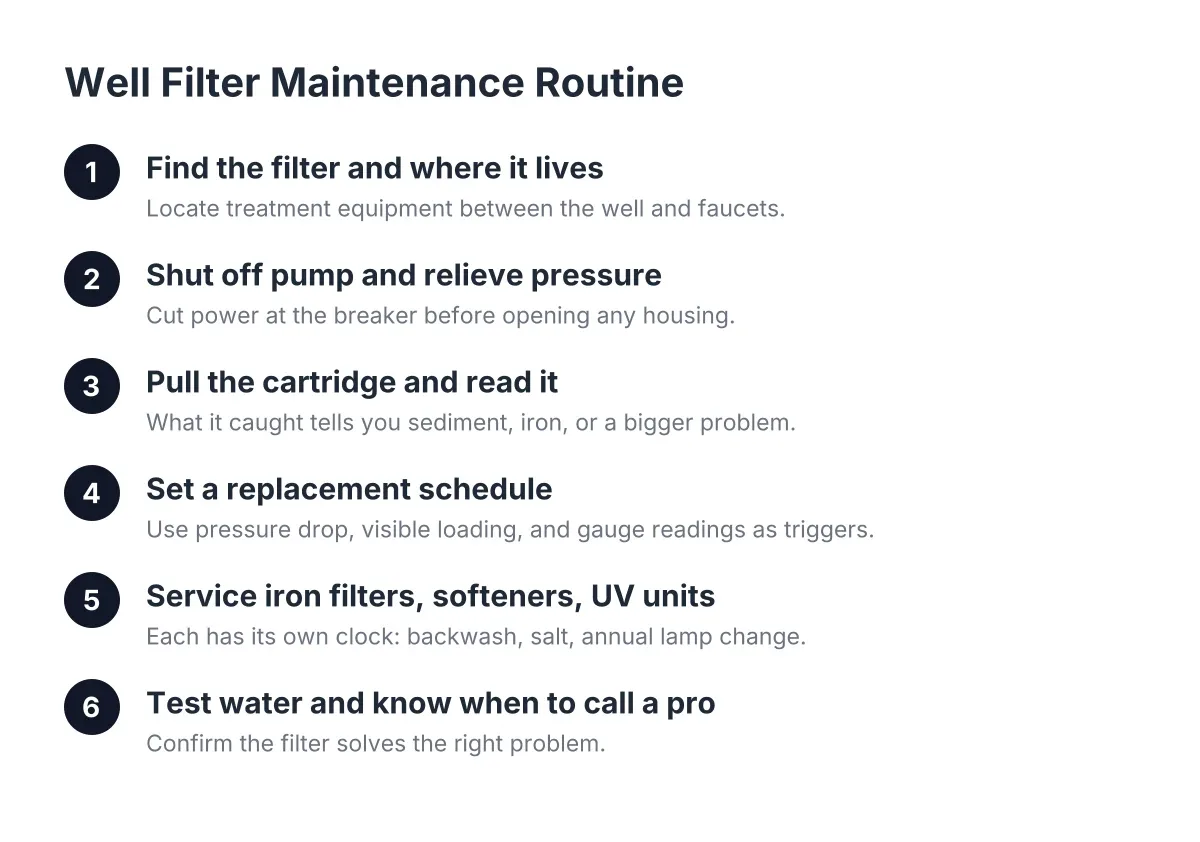
Between professional visits, someone on site should walk the system each season. No tools required. Look at the well cap and make sure it is intact and sealed. Listen near the pressure tank while someone runs a faucet; steady, spaced pump cycles are good, rapid clicking is not. Note the pressure gauge reading. Glance at any visible wiring and the area around the wellhead for standing water or new erosion.
For a landlord, this checklist is something a tenant can do and text you about. Four short reports a year will catch most developing problems months before they become a no-water call from an unhappy renter.
One note on shelter: a wellhead or above-ground pump does not require a fully enclosed well house. A simple three-sided lean-to that keeps rain and debris off while letting air move is often better than a tight enclosure that traps moisture around electrical components.
Layer three: the paper trail
Keep a single folder, paper or digital, with the well log from drilling if you have it, every inspection report, every water test, and every repair receipt. When a problem does come up, that history cuts diagnostic time, and diagnostic time is a big share of any emergency bill. It also adds real value when you sell a rural property, because buyers and their inspectors ask hard questions about wells.
Where Residential Well Maintenance Costs Pay Off: A Tale of Two Augusts
Suppose two homeowners outside Sandy each have a 25-year-old well with the original pressure tank. It is a hypothetical, but the pattern is one any well service tech would recognize.
The first homeowner skips maintenance. In August, during a stretch of dry weeks, the taps sputter and quit on a Sunday with family visiting. The emergency call reveals a waterlogged pressure tank that has been short cycling the pump for two years, and the pump motor is dead. Now the bill stacks up: emergency diagnosis, a new pump, a new tank, and possibly pulling and resetting the drop pipe. Using Angi's national figures as a reference point, pump replacement alone averages $1,898, and the tank and emergency timing push the total higher. The family hauls water for the days it takes to schedule and complete the work.
The second homeowner pays for an annual inspection. Two springs earlier, the technician flagged the tank losing its air charge and replaced it on a scheduled visit for a fraction of the eventual emergency total. The pump, no longer short cycling, keeps running. When it does eventually reach end of life, the owner has had years of warning, has priced the replacement in advance, and schedules the swap before failure. Same well, same pump, same climate. One owner chose when to spend; the other had the choice made for them.
The lesson is not that maintenance makes failure impossible. Pumps are machines, and every machine eventually quits. The lesson is that consistent well and pump maintenance moves the big expense from an emergency you absorb to a project you plan, and planned work is almost always cheaper work.
When Maintenance Is Not Enough: Repair, Replacement, or a New Well
Sometimes an inspection turns up news you did not want. A well that is losing yield, a casing problem, or a pump at the end of its life raises a harder question: repair, replace the pump, or drill new? There is no one right answer, and this is a decision to make with a professional who has actually looked at your system, not from a chart on the internet.
Still, the general cost ladder helps you think clearly. Pump and well repair sits at the bottom, often a few hundred to a few thousand dollars depending on what failed and how deep the pump sits. Full well pump replacement is the middle rung; Angi's data puts the national average at $1,898, with most projects landing between $975 and $2,821. Drilling a new well is the top rung. HomeAdvisor reports homeowners spend an average of $3,000 to $9,000 to drill a well, with an average around $5,500, and Angi puts per-foot drilling in the range of $25 to $65. Depth drives that number, and depth in our area varies a lot from one property to the next, so treat national averages as orientation, not a quote.
Depth is also why deeper wells tend to earn their cost over time. Shallow wells drawing from near-surface groundwater are more exposed to dry summers, while deeper wells tapping aquifers that change less with the seasons tend to hold up better in drought years. If your shallow well struggles every August, that pattern belongs in the conversation about long-term options.
If a new well does end up on the table, know what good practice looks like. Drillers reaching bedrock plan to drill at least about 10 feet into the rock to seal out dirty surface water and set casing properly, according to the New Hampshire Department of Environmental Services. After drilling, the well and pump components get disinfected with chlorine and the well is run hard to flush the residue out, per the San Diego County Department of Environmental Health, and a water sample is taken for testing once the disinfectant has cleared, a step the CDC describes as standard. A well drilling company near me search will turn up plenty of names; asking whether they follow steps like these will tell you who takes the work seriously.
Budgeting for Well Upkeep in 2026 Without Guesswork
Set aside a yearly well line item the way you would for a furnace or a roof, and the numbers stop being scary. For most owners around Gresham in 2026, a workable plan looks like this: budget for one professional inspection a year, in the range Angi cites of $250 to $550, plus a cushion for the minor fixes inspections tend to surface. Angi's broader figure of $200 to $900 per year for well maintenance is a reasonable planning band.
Then, separately, build a replacement reserve. If your pump is past its tenth birthday, start setting aside toward a future well pump installation so the eventual swap is a scheduled job, not a crisis loan. If your well itself is decades old and yield is slipping, fold a longer-term drilling reserve into the plan too, since HomeAdvisor notes most owners need to drill or re-drill a well every 10 to 20 years.
A few practical notes on buying this work well:
- Search terms matter less than questions. Whether you type water well maintenance near me, well repair near me, or well plumber near me, you will see similar lists. Ask each company what their inspection actually includes and whether you get a written report.
- Favor well specialists over generalists. Water well pump repair is its own trade; a plumber who rarely pulls pumps is learning on your well.
- Ask about service agreements. Some companies offer well service agreements that bundle the annual visit with priority scheduling. For a landlord with wells on multiple rural properties, an agreement per property turns water pump maintenance into a predictable operating cost instead of a string of surprises.
- Get the baseline in writing. Amp draw, pressure settings, tank charge, and test results from this year are the yardstick for next year.
The owners who get hurt by wells are not the ones who spend the most. They are the ones who spend nothing for a decade and then spend everything in a weekend. A few hundred dollars a year, a ten-minute seasonal walk-around, and one folder of records will not make your well immortal. It will make sure that when the pump finally does reach the end, you saw it coming, you priced it calmly, and nobody in your house ever turned on a tap and got nothing.
If you need well drilling, Clackamas Well Drilling can help.
Prefer to talk it through? Call (503) 782-5215 — a quick call is usually the fastest way to get a straight answer for your situation.