Well and Pump Maintenance — Complete Guide
Owning a well means owning a piece of infrastructure that works silently until the day it doesn't. Well pump maintenance is the discipline of catching small problems before they become no-water emergencies, and it matters twice as much when you manage properties you don't live in. This guide covers how often a well should be serviced, the seasonal checks worth doing, the warning signs a tenant can spot for you, and how service agreements turn unpredictable failures into a line item you can budget. If you own one rural home near Gresham or a handful of rentals scattered across Sandy, Boring, Damascus, and Estacada, this framework will help you plan service before something breaks.
What You'll Find in This Guide
How Often Should a Well Be Serviced? A Schedule for Owners Who Aren't On Site
The short answer: inspect annually, test water annually, and check the visible components every season. That cadence works for a homeowner who walks past the wellhead every day. However, it needs adjusting when you own the well but live thirty miles away.
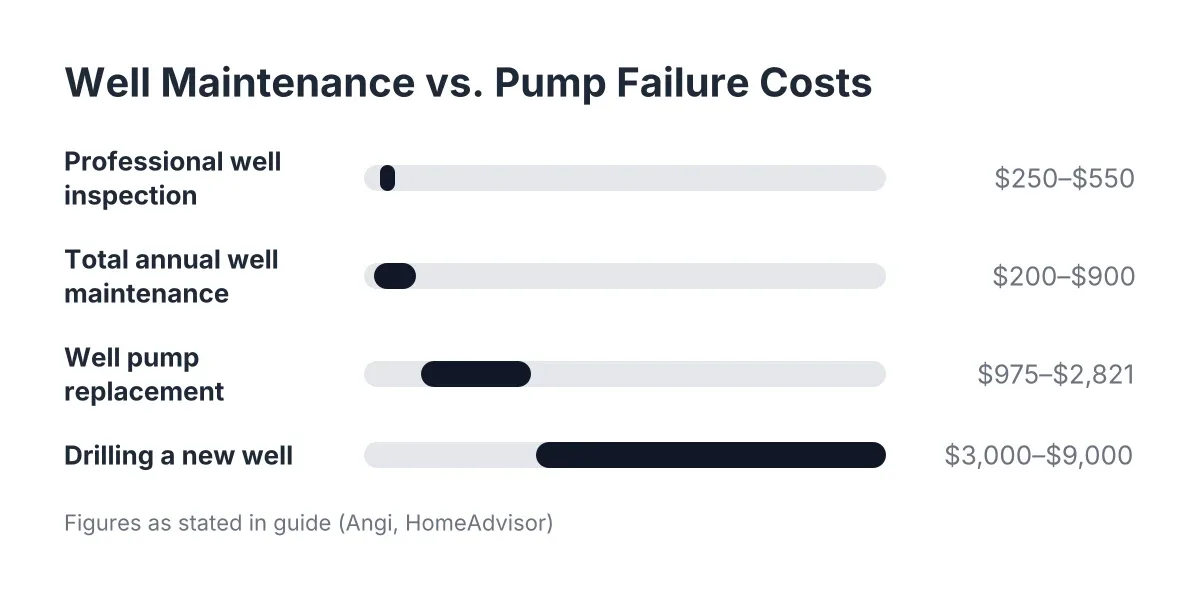
For a landlord or rural investor, the annual professional inspection becomes the anchor of your whole maintenance plan. It's the one guaranteed set of trained eyes on the system each year. According to Angi, a typical professional well inspection costs $250 to $550, and total well maintenance runs most owners $200 to $900 per year. That's a small number compared to the alternative. Angi also reports the national average well pump replacement cost is $1,898, with most homeowners paying between $975 and $2,821. In other words, one skipped inspection that lets a failing pump run itself to death can erase five years of maintenance savings.
An annual inspection around here should cover pump performance, pressure tank charge, pressure switch operation, wellhead condition, and a basic water quality test. Additionally, ask your contractor to log static water level whenever they open the well. Out on the Clackamas and Multnomah County rural edge, that number matters. The U.S. Geological Survey reports that about 1,220 domestic wells in Oregon went dry or fell below pumping capacity between June 2021 and December 2023, and the true figure is likely higher because reporting isn't mandatory. Tracking your water level year over year is the only way to see that problem coming instead of discovering it through a tenant's phone call.
Keeping Your Well and Pump in Good Maintenance Condition by Season
Between professional visits, a short seasonal checklist keeps you informed. In spring, check the wellhead after winter storms for cracks in the cap or standing water pooling around the casing. During summer, listen for the pump cycling more often than usual, since irrigation season stresses marginal wells. In fall, insulate exposed pipes and confirm the well house or pump cover is sealed against the weather. Through winter, watch for pressure drops during cold snaps, which often signal a frozen line or a struggling pressure switch.
For remote properties, hand this checklist to your tenant or property manager. To put it simply, they don't need to fix anything. They just need to know what "normal" looks like so they can report what isn't.
Signs Your Well Needs Servicing Before It Fails Outright
Most well pump failures announce themselves weeks in advance. The problem is that the signals are subtle, and the person best positioned to notice them usually isn't the person paying for repairs. With this in mind, train yourself and your tenants to recognize the early warnings.
Sputtering faucets are the classic red flag. Air in the lines usually means the water level has dropped near the pump intake, or the drop pipe has developed a leak. Either way, it deserves a service call before the pump starts running dry. Similarly, a pump that cycles on and off rapidly, sometimes called short cycling, often points to a waterlogged pressure tank. That's a cheap fix caught early. Left alone, the constant starts burn out the pump motor, and you're suddenly shopping for a replacement instead of a repair.
Beyond that, watch for these changes:
- Pressure that fades during showers or when two fixtures run at once
- A sudden jump in the electric bill at a property with a well, which often means the pump is running far more than it should
- Cloudy, sandy, or metallic-tasting water, which can indicate a failing screen, a corroded casing, or sediment intrusion
- Any change in how the water smells, especially a rotten-egg or musty odor
For example, a tenant in Corbett once noticing "the water tastes weird lately" is worth more to you than any gadget. As a result, smart landlords build a reporting habit into their lease communication. Ask about water pressure and water quality in your routine check-ins, the same way you'd ask about the furnace filter.
Why Early Detection Pays Off in Dollars
The economics here are straightforward. A pressure switch replacement or tank recharge is a modest service call. However, a pump that fails completely means emergency rates, a scrambling tenant, possibly a hotel bill, and in the worst cases a well that needs rework. Our guide to well and pump maintenance costs breaks down what each tier of intervention runs in the Gresham area, so you can see exactly where prevention beats reaction. HomeAdvisor pegs the average cost to drill a well at $5,500, with most projects landing between $3,000 and $9,000. That's the ceiling you're protecting against every time you act on an early warning instead of ignoring it.
Well Service Agreements: Extending Pump Lifespan Across Multiple Properties
A submersible well pump should last 10 to 15 years. In practice, its lifespan depends less on the hardware and more on the conditions it runs in. A pump that short cycles against a bad pressure tank, runs dry against a dropping water table, or pushes against sediment ages fast. Consequently, extending well pump lifespan is mostly about maintaining everything around the pump, not the pump itself.
This is where a service agreement earns its keep for a multi-property owner. Instead of scheduling and remembering annual inspections for three or four wells in three or four towns, you put every property on one contractor's calendar. The contractor handles the visits, logs the readings, and flags anything trending in the wrong direction. Meanwhile, you get one predictable annual cost per property and a paper trail for every well you own.
That paper trail matters more than most owners realize. When you eventually sell a rural property, a folder of annual inspection reports and water tests is a genuine asset. Buyers on well water worry about the unknown. Documented well pump maintenance removes the unknown, and it can keep a nervous buyer from demanding a price concession over a system that's actually healthy.
What a Good Agreement Should Include
Not every service agreement is worth signing. At minimum, look for an annual full-system inspection, an annual water quality test, priority scheduling when something does break, and written reports after every visit. Additionally, ask whether the agreement includes static water level measurement. On the east side of the metro, where the U.S. Geological Survey has documented hundreds of Oregon wells dropping below pumping capacity in recent years, water level history is the single most valuable data point you can accumulate.
For water testing standards, the Oregon Health Authority's domestic well safety program recommends testing for coliform bacteria, nitrates, and arsenic. A good agreement covers those basics and explains the results in plain English, not just a lab printout.
Finally, weigh the cost honestly. If an agreement runs a few hundred dollars per property per year, compare that against one emergency pump replacement at nearly two thousand dollars, plus the tenant relations cost of a dry rental. For most owners with more than one well, the math resolves quickly. Our maintenance cost guide lays out the local numbers so you can run that comparison for your own portfolio.
Ready to Get Started?
If you own wells around Gresham, Sandy, Boring, Damascus, Estacada, or Corbett and you'd rather plan service than react to failures, we can help. We inspect, test, repair, and replace well and pump systems across the east metro's rural edge, and we'll give you straight answers about cost before any work starts. Reach out to set up an inspection for one property or a maintenance schedule for all of them.