Well Pump Replacement — Complete Guide
A dead well pump means no water in the house, and no water forces fast decisions under pressure. This guide walks you through the choice every Gresham-area well owner eventually faces: repair the pump you have, or replace it with one that will last another 10 to 15 years. You will learn how long well pumps typically last, which failure signs point to replacement, and what drives your water pump replacement cost here on the east side of the Portland metro. By the end, you should be able to talk to any contractor with confidence and spot a quote that does not add up.
What You'll Find in This Guide
Repair or Replace: How to Tell When Your Pump Is Actually Done
The most expensive mistake in the well business is replacing a pump that a $300 repair would have fixed. The second most expensive mistake is repairing a pump that fails again six months later. To avoid both, you need two pieces of information: the pump's age and the nature of the failure.
Most submersible well pumps last 10 to 15 years. Jet pumps, which sit above ground, often run closer to 8 to 12. However, those ranges shift based on how hard the pump works. A pump feeding a household of six on a 300-foot well cycles far more than a pump serving a weekend cabin in Corbett. Sediment matters too. Wells in the Sandy and Boring area that pull fine silt wear out impellers faster than wells in cleaner aquifers.
With age in mind, apply a simple rule. If your pump is under 8 years old and the problem sits outside the pump itself, repair usually wins. For example, a failed pressure switch, a waterlogged pressure tank, or a bad check valve can all mimic pump failure. Each one costs a fraction of a new pump. On the other hand, if the pump is past the 10-year mark and the motor itself has failed, replacement is almost always the smarter spend. Pulling a submersible pump from a deep well carries real labor cost. Consequently, paying that labor twice, once to repair an old pump and again to replace it a year later, is the outcome you want to avoid.
Warning Signs That Point to Replacement
Certain symptoms tilt the decision toward a new pump. Watch for sputtering faucets that spit air, pressure that drops noticeably when two fixtures run at once, and a pump that cycles on and off rapidly. Additionally, a spike in your electric bill often signals a motor that is straining to do its job. Cloudy or sandy water can mean the pump has dropped too close to the bottom of the well, or that the well itself needs attention. None of these signs alone settles the question. Together with the pump's age, they tell you whether you are patching a system or prolonging a slow failure.
Estimating the Cost of Water Pump Replacement
Pricing is where most homeowners feel lost, because quotes for the same job can vary by thousands of dollars. To put it simply, three factors set your water pump replacement cost: well depth, pump type, and the condition of everything attached to the pump.
Depth matters most. A deeper well needs a more powerful pump, more drop pipe, more wire, and more labor to pull and reset the unit. Around Gresham, Damascus, and Estacada, residential wells commonly run from under 100 feet to several hundred feet, and that spread alone can double the price of a job. Pump type comes second. A shallow-well jet pump costs far less than a high-horsepower submersible rated for a 400-foot well. Finally, the surrounding system matters. If your pressure tank, wiring, or pitless adapter is failing too, replacing them during the same visit saves you a second service call but raises the invoice.
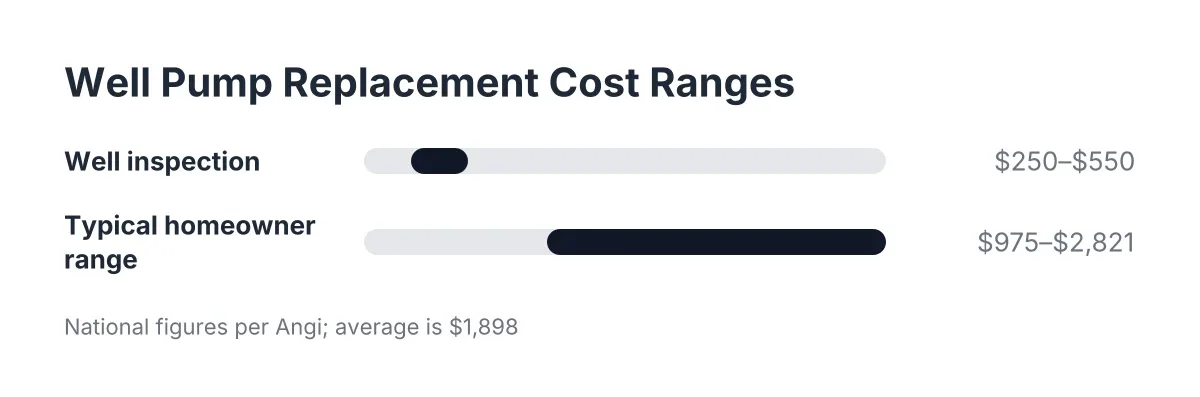
For a national reference point, the average well pump replacement runs $1,898, with most homeowners paying between $975 and $2,821, according to Angi. That range is a useful sanity check, not a quote. Deep wells on the Clackamas County rural edge often land above it, while a straightforward jet pump swap can land below it. Our full well pump replacement cost guide breaks the numbers down line by line so you can see where your money actually goes.
How to Avoid Overpaying
Ask every contractor to itemize the quote: pump, drop pipe, wire, labor, and any tank or electrical work. As a result, you can compare bids on equal terms instead of guessing. Additionally, ask what horsepower and brand of pump they plan to install, and whether the price includes pulling the old unit. A vague lump-sum number is the most common sign of a padded bid. That said, the cheapest quote is not automatically the best one. An undersized pump saves money on day one and burns itself out early by short-cycling against demand it cannot meet.
The Replacement Process and Choosing the Right Pump
Once you decide to replace, the job itself moves quickly. In practice, most residential pump replacements finish in a single day, and your water comes back on before the crew leaves.
The process follows a clear sequence. First, the technician confirms the diagnosis by testing power at the wellhead and checking the pressure tank, because replacing a pump when the real fault is a $40 switch helps no one. Next, the crew pulls the old pump. For a submersible, that means lifting the entire drop pipe assembly out of the casing, which can run hundreds of feet. Then they inspect the pipe, wiring, and torque arrestor, and replace anything worn. Finally, they set the new pump at the correct depth, reconnect the pitless adapter, pressurize the system, and flush the lines. A good crew also disinfects the well after opening it, which protects your water quality. If you want to understand what healthy well water should look like afterward, the Oregon Water Resources Department publishes solid guidance for private well owners at oregon.gov/owrd.
Submersible vs Jet Pump: Which Replacement Makes Sense
Your well largely makes this choice for you. Submersible pumps sit down in the water and push it upward, which makes them the standard for wells deeper than about 25 feet. Jet pumps sit above ground and pull water up, so they only suit shallow wells. Because most wells in the Gresham and east metro area run well past jet-pump territory, submersibles dominate here. However, if you currently run a jet pump on a shallow well, converting to a submersible during replacement can be worth discussing. Submersibles run quieter, last longer, and deliver steadier pressure.
Sizing matters as much as type. Match the pump's flow rate to your well's actual yield and your household's demand. Beyond that, consider a constant-pressure system if you irrigate or run multiple bathrooms, since it holds pressure steady instead of swinging between cycles. One more note on budgeting: replacement is not always the end of the story. If a well itself has collapsed or run dry, no pump will fix it. Homeowners spend an average of $5,500 to drill a well, according to HomeAdvisor, so a proper inspection before you buy a new pump protects you from putting good equipment into a bad well.
Ready to Get Started?
If your pump is failing or already dead, you do not have to guess your way through the repair-or-replace decision alone. We serve well owners across Gresham, Sandy, Boring, Damascus, Estacada, Corbett, and Oregon City with honest diagnosis, transparent pricing, and same-day answers. Call us, tell us what your water is doing, and we will tell you exactly what it will take to get it flowing again.