Well Pump Constantly Cycles On and Off? Pressure Tank, Switch, and Waterlogging Fixes
If your well pump constantly cycles on and off, clicking every minute or two even when nobody is running water, something in the pressure system is lying to the pump. Well pump short cycling — when the pump turns on and off far more often than it should — has nine times out of ten one of three causes: a waterlogged pressure tank, a worn or sticking pressure switch, or a leak somewhere between the pump and your faucets. The good news is you can narrow it down yourself in about twenty minutes with a tire gauge and your own ears, before you ever pick up the phone.
This guide walks through those checks in order, from the most common cause to the least. By the end you should be able to tell a well and pump technician exactly what you found: "tank reads zero air pressure, water came out of the air valve" is a diagnosis, not a guess. That kind of detail gets you a faster repair, an honest quote, and a lot less worry that someone is going to upsell you during an emergency.
What Rapid Cycling and Well Pump Short Cycling Actually Means
Rapid cycling, sometimes called short cycling, means the well pump turns on and off far more often than it should. Instead of running for a minute or two and then resting while the pressure tank does its job, the pump kicks on for a few seconds, shuts off, and kicks on again. You will hear the pressure switch click repeatedly, and you may see the pressure gauge needle bouncing like a windshield wiper.
Here is why that matters. A residential well system typically pairs a submersible pump down in the well with a pressure tank, which may sit in the well, in the house, or in a crawl space, according to the Indiana Department of Health. The tank's whole job is to store water under pressure so the pump does not have to start every time someone rinses a glass. Without a working pressure tank, the pump would run straight to every faucet demand, overworking itself and cycling constantly.
So how often should a well pump cycle on and off? Under normal use, the pump should run long enough to refill the tank, then rest until the stored water is used up. If you hear it starting more than once a minute, or starting at all when no water is running, the system is short cycling and something needs attention.
Starting an electric motor is the hardest moment of its life. Every start pulls a surge of current and heats the windings. A pump that starts hundreds of extra times a day wears out years early, and a worn switch can even get stuck in that high-draw startup phase and trip the breaker. Catching rapid cycling early is the difference between a modest well pump repair and a full well pump replacement, which according to Angi averages $1,898 nationally, with most homeowners paying between $975 and $2,821.
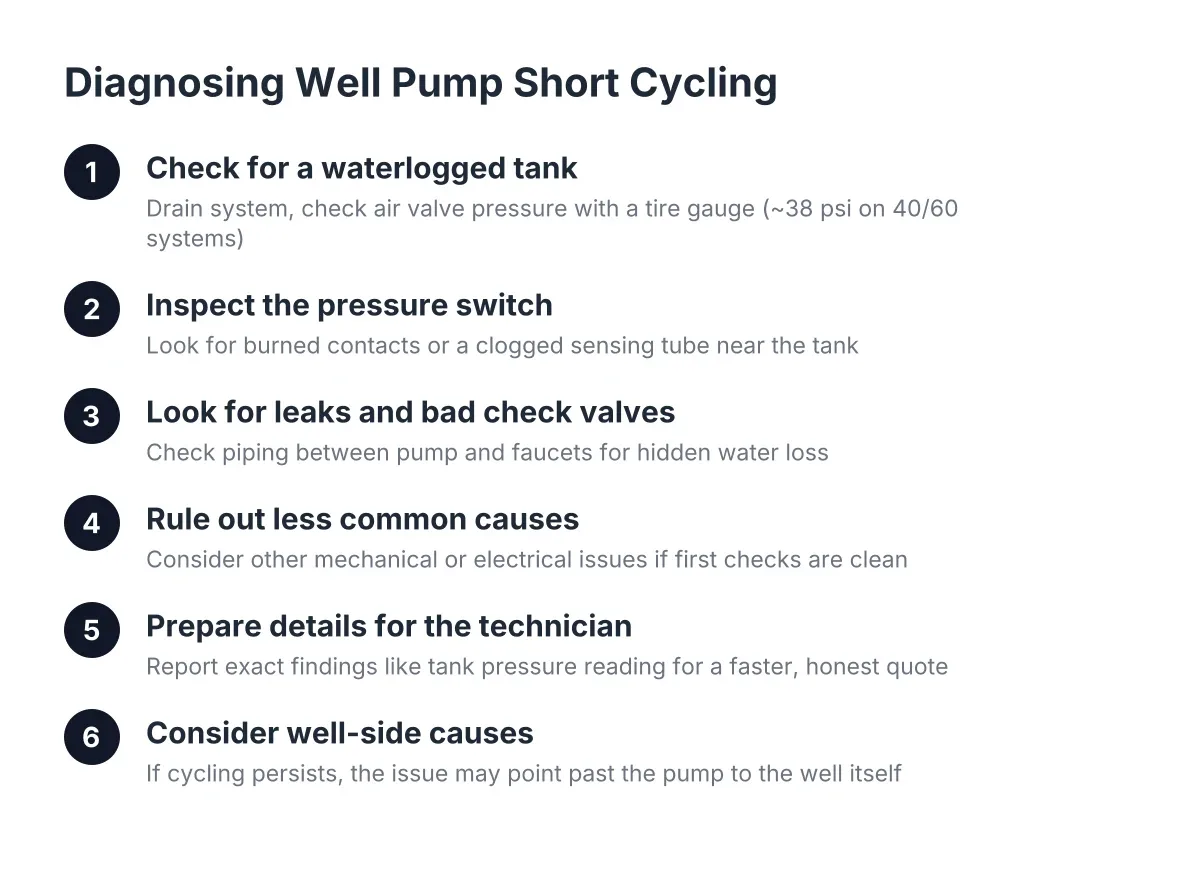
First Check: Is the Pressure Tank Waterlogged?
A waterlogged pressure tank is the most common reason a well pump constantly cycles. Inside the tank, a rubber bladder or diaphragm separates pressurized air from your well water. The air acts like a spring. When that bladder fails or the air charge leaks away, water fills the whole tank, the spring is gone, and pressure crashes the instant anyone opens a tap. The pump then has to restart over and over to keep up.
The telltale symptom, besides the cycling itself, is surging water at your fixtures. Suppose you are in the shower in your Boring or Damascus house and the spray pulses strong, weak, strong, weak, while you hear the pump clicking on and off somewhere below you. That rhythm of fluctuating pressure at the showerhead paired with rapid cycling points at the tank almost every time.
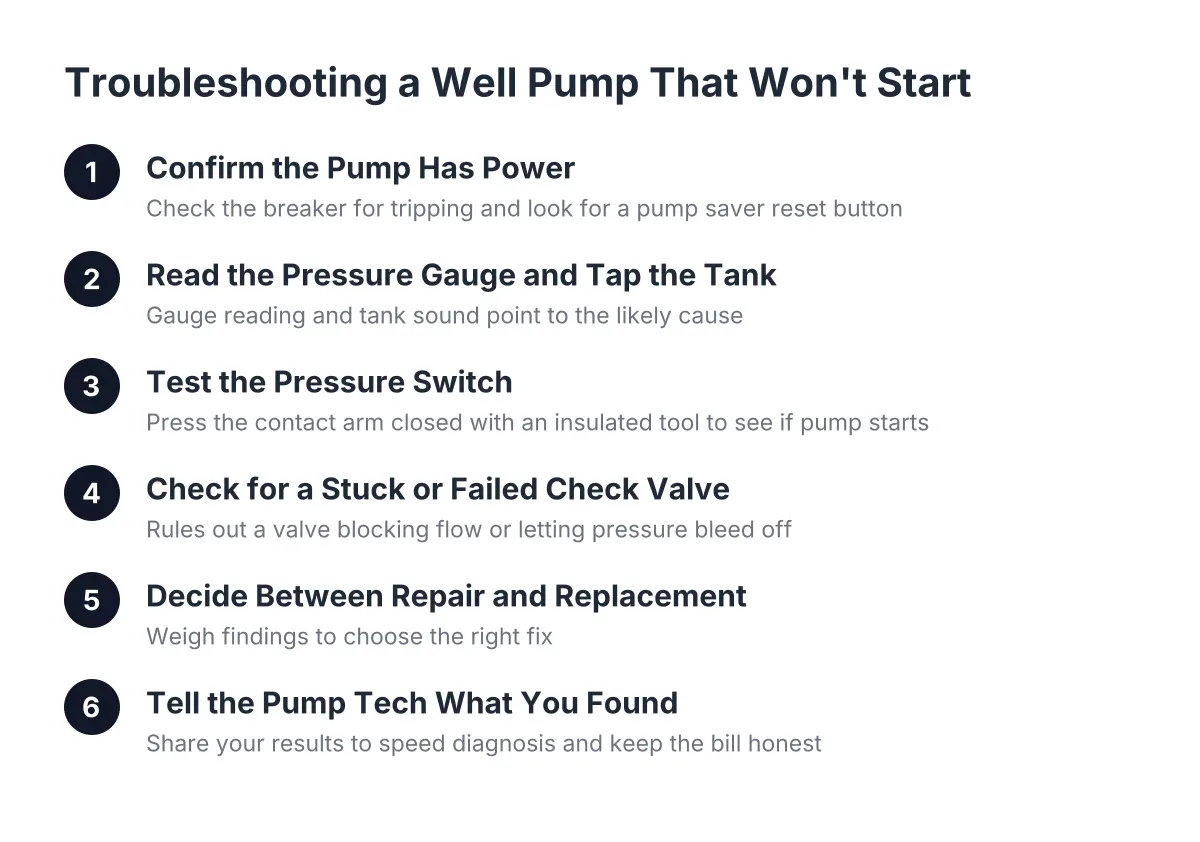
Here is how to check the tank yourself:
- Turn off power to the pump at the breaker. Never work on the system live.
- Open a faucet and drain the system until the pressure gauge reads zero.
- Find the air valve on top of the tank. It looks like a tire valve under a plastic cap.
- Press a tire pressure gauge onto the valve, the same one you use on your truck.
- Read the result. A healthy tank holds air at about 2 psi below the pump's cut-in pressure. On a common 40/60 system, that means roughly 38 psi.
Two results tell you the tank is done. First, if water spits out of the air valve when you press the gauge, the bladder has ruptured and the tank needs replacement; no amount of added air will hold. Second, if the gauge reads at or near zero but no water comes out, the tank has lost its charge. You can add air with a bicycle pump or compressor to the correct pressure, restore power, and watch. If the cycling stops and stays stopped for weeks, you may have just fixed it. If the air leaks back out in days, the bladder is pinholed and the tank is on borrowed time.
Tank replacement is a routine job for any well pump repair outfit. It is also one of the cheapest fixes in the well world relative to what it prevents, because a dead tank quietly destroys the far more expensive pump sitting a couple hundred feet down the well.
Second Check: Pressure Switch Issues When Well Pump Short Cycling Occurs
If the tank checks out and the well pump keeps cycling on and off anyway, look at the pressure switch next. This is the small gray or black box, usually mounted on a short pipe nipple near the tank, that tells the pump when to start and stop. It closes its contacts at the cut-in pressure and opens them at the cut-out pressure. When it goes bad, it sends the pump garbage signals.
Three switch problems cause cycling:
- Burned or pitted contacts. Every pump start arcs the contacts. Over years they pit, stick, and chatter, making the pump flutter on and off. If you shut off power, remove the switch cover, and see blackened or welded-looking contact points, the switch is failing.
- A clogged sensing tube. The switch reads pressure through a small tube or nipple. Sediment and iron scale, common in well water around the Gresham and Sandy area, can plug it. The switch then reacts late or erratically, and in bad cases the pump cycles multiple times per second.
- A switch set too close together. If the gap between cut-in and cut-out pressure is too narrow, the pump starts and stops over a trivial pressure swing. Standard gaps are 20 psi, such as 30/50 or 40/60.
Always kill the breaker before you open the switch cover. There are live 240-volt contacts inside, and the plastic cover is the only thing between them and your fingers.
One related question comes up constantly: how to reset a pressure switch on a well pump without a lever. Many switches have a low-pressure cutout lever on the side; it exists to shut the pump off if pressure drops abnormally low, such as after a burst line, so the pump cannot run dry. If your switch has no lever, there is nothing to hold. The switch resets itself once system pressure climbs past cut-in. In practice, you cycle the breaker off and back on, and if pressure is too low for the contacts to close, you lightly tap the switch body or briefly jump the contacts only if you know exactly what you are doing. If that sentence made you nervous, stop and call a pro; this is the one spot in well pump troubleshooting where guessing can hurt you.
If you do replace the switch yourself, or watch a technician do it, there is a smart follow-up step. Run water and cycle the system on and off several times, confirming the pump does not overheat, the breaker holds, and the system keeps pressure without slowly bleeding down. A new switch on top of a hidden leak just masks the real problem for a few weeks.
Third Check: Leaks and Check Valves That Make a Well Pump Cycle Constantly
Pressure that leaks away forces the pump to restart, so a system that loses pressure overnight will make the well pump cycle constantly even with a perfect tank and switch. The tell is simple: the pump runs when every faucet in the house is closed. Water is going somewhere it should not.
Start with the easy suspects inside the house. A running toilet flapper is the classic culprit; it can bleed pressure all night and make a landlord think the well is failing. Check every toilet, the water softener if you have one, outdoor spigots, and any irrigation zones. Then watch the pressure gauge with all water off. If the needle falls steadily, you have a leak.
However, if the house side holds and the gauge still drops, the leak is upstream of the tank. The two usual causes are a failed check valve or foot valve, which is supposed to keep water from draining backward down the well when the pump stops, and a leak in the drop pipe or the buried line between the wellhead and the house. Both let the system bleed pressure back into the well itself. You cannot see either one from the surface, and fixing them means pulling the pump or excavating line, which is professional territory.
For example, say a landlord owns a rental outside Estacada and the tenant reports the pump clicking all night with no water running. The toilets check out, the tank holds its air charge, but the gauge drops from 55 to 38 psi in ten minutes with the house valved off. In that scenario the smart money is on a failed check valve or a cracked drop pipe, and the useful call to a well pump repair company is "pressure bleeds down with the house isolated," not "my pump keeps running." That one sentence saves a diagnostic hour.
Leaks also explain a confusing variant: the well pump not working with the breaker not tripped. Some switches with a low-pressure cutout will lock the pump off when a big leak drops pressure below their floor, which is the switch protecting the pump from running dry. Power is fine, the breaker is fine, and the pump sits silent until the cutout is reset and the leak is fixed.
Less Common Reasons a Well Pump Constantly Cycles
Tank, switch, and leaks cover most cases, but a few other causes show up, especially on older rural systems around Corbett, Oregon City, and the Clackamas and Multnomah County edge where private wells are the norm rather than the exception.
- A clogged pump intake or failing pump. Sediment, iron bacteria, or scale can choke the pump's intake screen. The pump builds pressure slowly, overshoots, stalls, and cycles. Sudden sediment in your well water alongside cycling is a flag worth mentioning when you call.
- A well struggling to keep up. If the aquifer level has dropped, the pump may pull the water level down to its intake, lose prime, and stumble on and off. This matters in Oregon; according to the U.S. Geological Survey, about 1,220 domestic wells in the state went dry or fell below pumping capacity between June 2021 and December 2023, and the true figure is likely higher since reporting is not mandatory. Modern constant pressure systems often include a dry-run safety that shuts the pump off automatically so the well can recover, which can look like mysterious cycling or shutdowns from the house.
- A waterlogged galvanized tank with no bladder. Older steel tanks lose their air cushion gradually and need periodic recharging. If your tank is a bare galvanized cylinder with no bladder, expect this as routine maintenance rather than a failure.
- An undersized tank. A tank too small for the household demand forces frequent starts even when nothing is broken. This shows up after additions, new irrigation, or a rental that went from one tenant to a family of five.
If your real complaint is weak flow rather than cycling, the question of how to fix a water pump with no pressure runs through the same checklist: confirm the tank's air charge, confirm the switch's settings and contacts, then look for restrictions like a clogged sediment filter or a half-closed valve. Decreased pressure, inconsistent supply, or a total loss of pressure can also signal a pump that is simply wearing out after fifteen or twenty years downhole.
What to Tell the Technician, and What the Visit Should Look Like
When you call for well pump repair, the twenty minutes of checking you just did becomes real leverage against emergency-call anxiety. You are no longer saying "my well stopped working, help." You are saying what you measured. A useful report sounds like this:
- How often the pump cycles, and whether it runs with all water off
- The tank's air pressure reading, and whether water came out of the air valve
- The pressure switch setting if it is labeled, such as 30/50 or 40/60
- Whether the gauge bleeds down with the house valved off
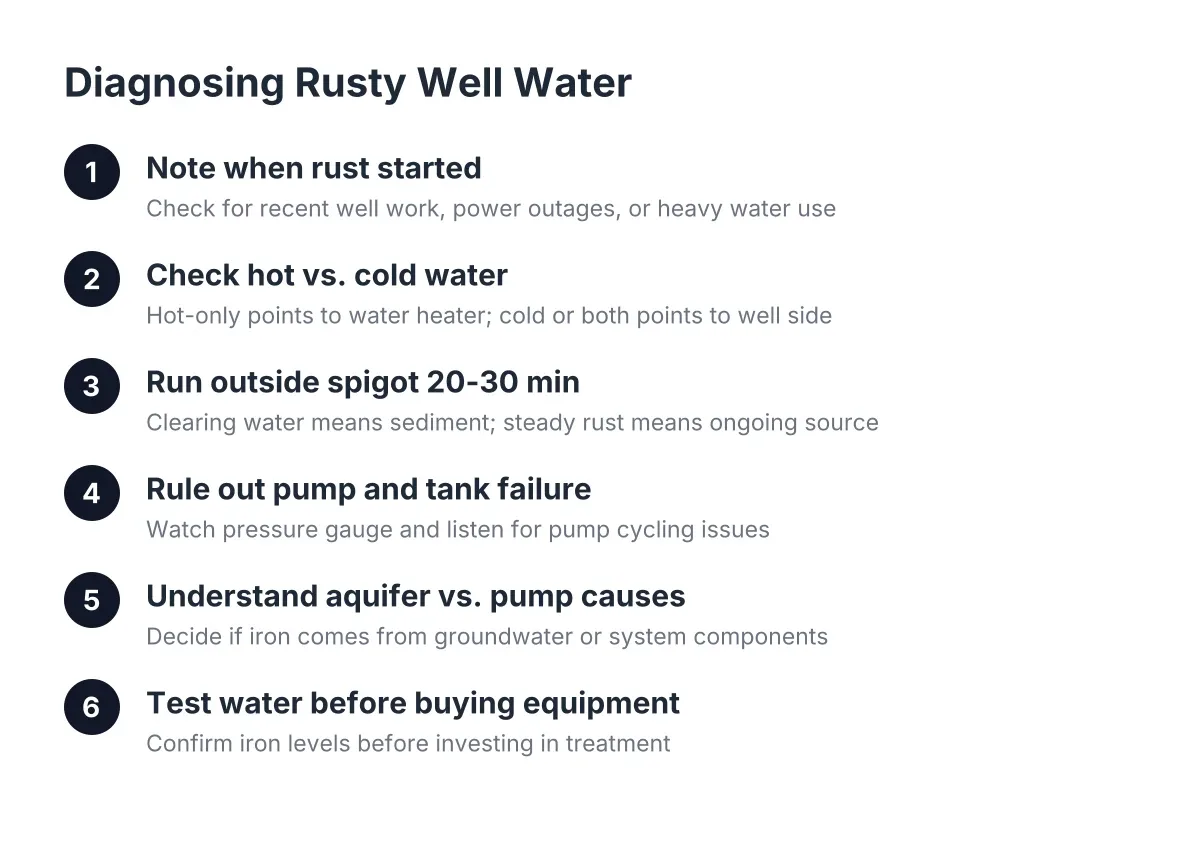
- Any new sediment, odd taste, or color in the well water
A technician hearing "tank reads 4 psi, pump cycles every 45 seconds, no leaks inside" can show up with the right tank on the truck instead of making a second trip. For a homeowner with a house full of people and no reliable water, that difference is the whole ballgame. For a landlord juggling several well-served rentals, it is the difference between a same-week fix and a vacancy-threatening saga, and it is why keeping a simple log of each property's tank size and switch setting pays for itself.
Expect the visit itself to be methodical, not mysterious. A good tech will verify your tank reading, pull the switch cover, check pump amperage, and test whether the system holds pressure. If a switch gets adjusted, the careful habit is to bring power back gradually while watching the gauge, so an over-pressurized system drips at the relief valve instead of bursting something. If the trail leads down the well to a check valve or the pump itself, ask to see the old parts when they come up. Honest outfits show you the failed bladder or the corroded valve without being asked.
Cost-wise, keep the scale in mind. Routine well maintenance runs $200 to $900 per year for most homeowners, and a professional well inspection typically costs $250 to $550, according to Angi. A pressure tank or switch fix sits at the low end of pump work; a full pump replacement averages $1,898 per Angi's project data; and only in rare cases, such as a well that can no longer produce, does the conversation turn toward well drilling, where HomeAdvisor puts the average cost to drill a well at $5,500, with most projects between $3,000 and $9,000. Catching a cycling problem early keeps you at the cheap end of that ladder.
When Cycling Points Past the Pump to the Well Itself
Most cycling complaints end at the tank or the switch, and that is the outcome to hope for. Occasionally, though, the symptom is the well telling you its water level or production has changed. If the pump cycles because it keeps sucking air, if neighbors on nearby wells report the same trouble, or if the problem arrives with sand and sediment after years of clean water, the diagnosis shifts from pump and well repair toward a deeper look.
That is where a well inspection and an aquifer and well depth assessment earn their keep. A technician can measure the standing water level, check the pump's depth setting, and tell you whether the pump can be lowered, whether the well needs rehabilitation, or in the worst case whether a new well makes more sense than chasing repairs. None of that can be diagnosed from the pressure tank in your garage, and no honest answer about it comes over the phone sight unseen.
One honest limitation to close on: everything in this guide assumes you are comfortable around a breaker panel and a tire gauge, and that your system is a standard tank-and-switch setup. Constant pressure systems, two-pump setups, and anything involving opening a live switch or pulling a pump belong with a professional. The point of checking first is not to replace the service call. It is to walk into that call informed, able to describe the problem in plain terms, and confident that whatever fix gets proposed actually matches what you observed with your own eyes.
If you need well drilling, Clackamas Well Drilling can help.
Prefer to talk it through? Call (503) 782-5215 — a quick call is usually the fastest way to get a straight answer for your situation.