Well Pump Won’t Turn On? Electrical, Pressure Tank, and Check Valve Fixes
When a well pump won't start, the problem usually lives in one of three places: the electrical supply, the pressure switch and tank, or a stuck check valve. The good news is you can check all three without pulling the pump, and most of the checks take under ten minutes. This guide walks through them in order, the same order a pump tech works through on a service call in Gresham, OR. By the end you will either have water running again or you will know exactly what to tell the person you call, which keeps the diagnosis fast and the bill honest.
A quick note before you start. Most homes on private wells around Gresham, Boring, Damascus, and Sandy run a submersible pump down the well paired with a pressure tank in the house, garage, or crawl space, according to the Indiana Department of Health. Everything below assumes that setup. If you have an above-ground jet pump, the electrical checks still apply, but the priming issues are covered in a separate guide.
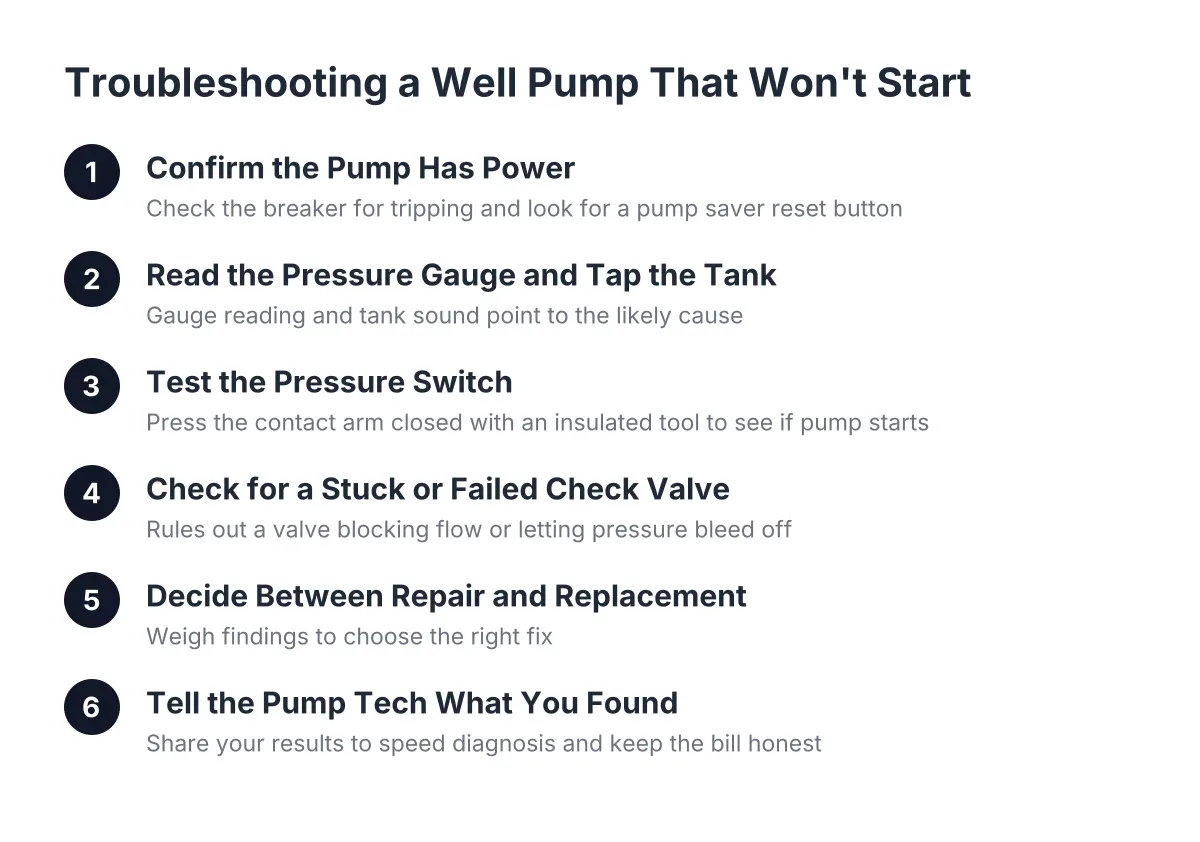
Step 1: Confirm the Pump Has Power
First, go to your electrical panel and find the breaker labeled for the well or pump. A well pump that won't start is a breaker problem more often than people expect. Look for a breaker sitting in the middle position, which means it tripped. Flip it fully off, then back on, and listen near the pressure tank for a click and the hum of the pump starting.
If the breaker trips again right away, stop. A breaker that will not hold usually means a short in the wiring, a seized pump motor, or a failed start capacitor on the control box. Repeated resetting can damage the motor further, and this is the point where a water well pump repair call makes sense.
Next, check for a well pump reset button. Some systems have a pump saver or low-water cutoff device mounted near the pressure tank or control box. Constant pressure systems in particular often shut the pump off automatically if they sense the well running low, which protects the pump and lets the aquifer recover. If that device tripped, press the reset and watch what happens. If it trips again within a few minutes, you may have a water supply issue rather than a pump failure, and running the pump dry will destroy it.
Step 2: Read the Pressure Gauge and Tap the Tank
Walk to your pressure tank and read the gauge. This single reading tells you more than anything else, and it is the first thing a pump tech checks on a no-water call.
Here is how to read what you see:
- Gauge at zero and the pump is silent: The pump is not getting power or the pressure switch is not closing. Go to Step 3.
- Gauge at zero or low and the pump hums but no water moves: Possible stuck check valve, dry well, or failed pump. A buzzing sound with no pumping often means the motor is trying to start and cannot. Cut power and go to Step 4.
- Gauge reads normal pressure but no water at the faucets: The problem is likely between the tank and the house, such as a frozen line or closed valve, not the pump itself.
- Gauge bouncing rapidly while the pump clicks on and off: That short cycling points to a waterlogged tank or a failing switch. See Step 5.
While you are there, knock on the side of the tank. The top should sound hollow and the bottom should sound dull. If the whole tank sounds full, it is waterlogged, meaning the air charge is gone. However, a tank low on air is a different problem from a pump that never starts. Low air alone does not explain a total loss of pressure; it explains rapid cycling and pressure that swings up and down.
Step 3: Testing the Pressure Switch When the Well Pump Won't Start
The pressure switch is a small gray box, usually mounted on the pipe near the tank, and it is the most common reason a well pump won't turn on when everything else looks fine. The switch senses pressure in the tank. When pressure drops to the cut-in point, its contacts close and send power to the pump. Corroded, burned, or stuck contacts mean the pump never gets the signal.
You can test it. With the cover off and your hands clear of any wiring, use the insulated plastic handle of a pair of pliers to gently press the contact arm closed. If the pump kicks on immediately, the switch is your problem, and a replacement switch is one of the cheaper parts in the whole system. If nothing happens even with the contacts closed, the failure is downstream, either in the wiring, the control box, or the pump motor itself.
Two safety rules here. Shut the breaker off before removing the switch cover or touching anything with a bare hand or metal tool; those contacts carry full pump voltage. In addition, after any switch replacement, cycle the system several times by running water. Confirm the pump starts cleanly, shuts off at the cut-out pressure, and holds pressure without bleeding back down. A system that loses pressure with no water running points you straight to Step 4.
Troubleshooting When Your Well Pump Won't Start But the Switch Clicks
A pressure switch that clicks closed while the pump stays silent means power is leaving the switch but not reaching a working motor. On most Gresham-area submersible systems, the suspects are the control box capacitor, the wiring splice down the well, or the pump motor itself. All three require a meter and, often, pulling the pump, which is professional territory.
There is one more pattern worth knowing. A switch with worn contacts can connect intermittently, causing the pump to rapid-cycle and get stuck in its high-amp startup phase. That shows up as a buzzing or chattering sound at the tank. Cut the power if you hear it, because every stuck start attempt cooks the motor a little more.
Step 4: Check for a Stuck or Failed Check Valve
The check valve is a one-way gate that keeps water in the pipe from draining back down the well when the pump shuts off. When it fails, two things happen. Pressure bleeds off overnight, so the pump cycles while no one is using water. Worse, a check valve stuck shut can block flow entirely, so the well water pump runs but no water pressure ever builds.
You cannot see a down-well check valve without pulling the pump, but you can read the symptoms:
- Pressure drops to zero within minutes or hours of the pump shutting off, with no faucets running.
- The pump runs constantly or the well pump won't turn off, because the system never reaches cut-out pressure.
- You hear water falling back down the well casing after the pump stops.
Any of these on a submersible system means the valve, or the drop pipe it sits on, needs attention. That is a pump-pull job. For a landlord with a tenant reporting the water pump not pumping water to the house, this is the scenario where a same-week well pump repair visit beats days of troubleshooting over the phone, because the fix happens at the bottom of the well, not at the tank.
Step 5: Decide Between Repair and Replacement
By now you know which of the three systems failed. Here is the honest decision framework, and where costs land as of 2026.
Suppose a landlord in Damascus has a rental where the pump hums but never builds pressure. If the test in Step 3 shows a dead switch, that is a minor part plus a short service visit, often the cheapest outcome in well pump troubleshooting. If the pump itself has failed, Angi reports the national average well pump replacement cost at $1,898, with most homeowners paying between $975 and $2,821. Depth, pump size, and wire condition move that number, and deeper Gresham-area wells sit toward the higher end.
For land buyers planning new construction, the same diagnostic logic applies to an unknown existing well on a property you are buying. Before closing, a well inspection, which Angi puts at $250 to $550, plus a water test tells you whether you are inheriting a working system or budgeting for a new one. If the well itself is the problem, HomeAdvisor reports homeowners spend $3,000 to $9,000 to drill a well, with an average of $5,500. Knowing that before you break ground beats finding out after.
One limitation worth stating plainly: everything in this guide stops at the top of the well. Anything involving pulling a submersible pump, down-well wiring, or amperage testing on the motor belongs with a licensed well and pump professional, both for safety and because the equipment is heavy and easy to drop.
What to Tell the Pump Tech When You Call
If your well pump won't turn on after these checks, you now have real information. When you call for well pump repair in Gresham, OR the surrounding rural edge, lead with these details:
- Whether the breaker held or tripped again after reset
- The pressure gauge reading, and whether it bleeds down overnight
- Whether jumping the switch contacts started the pump
- Any buzzing, clicking, or rapid cycling you heard at the tank
- The age of the pump and tank, if you know it
That list turns a two-hour diagnostic visit into a focused repair, and it signals to the tech that you know what you are looking at. For a rural investor managing several well-served rentals, keeping a one-page log of each property's gauge readings and pump age makes every future no-water call faster and cheaper to resolve.
If you need well drilling, Clackamas Well Drilling can help.
Prefer to talk it through? Call (503) 782-5215 — a quick call is usually the fastest way to get a straight answer for your situation.