Well Pump Troubleshooting — Complete Guide
When your faucet sputters and dies, well pump troubleshooting is the fastest way to figure out what went wrong before you spend a dollar. Most no-water emergencies trace back to a handful of causes, and you can check several of them yourself in under twenty minutes. This guide walks you through the symptoms Gresham-area homeowners see most: no water at all, weak pressure, a pump that cycles constantly, a breaker that keeps tripping, and sudden sediment in the water. By the end, you will know what you can safely check on your own, what the symptoms usually mean, and how to describe the problem clearly when you call a professional.
What You'll Find in This Guide
No Water From the Well: Where to Start Checking
Nothing gets your attention like turning a handle and getting silence. Before you assume the worst, work through the basics, because the fix is often simpler than a dead pump.
Start at the electrical panel. A tripped breaker is the single most common reason a well has power but no water reaches the house, or seems to. Find the breaker labeled for the well pump and check whether it sits in the middle position. If it does, flip it fully off, then back on, and wait a minute or two for the pump to build pressure. However, if it trips again right away, stop resetting it. A breaker that will not stay on points to an electrical fault, and repeated resets can damage the motor.
Next, check the pressure switch. This small gray box near your pressure tank tells the pump when to run. Sometimes ants, moisture, or corroded contacts keep it from closing. Additionally, look at the pressure gauge beside it. A reading of zero means the pump is not running or cannot move water. A normal reading with no flow at the tap suggests a plumbing problem past the tank instead, such as a frozen line or a failed valve.
Diagnosing Well Pump Issues When the Pump Runs but Nothing Comes Out
Here is the scenario that confuses people most: you can hear the pump running, yet the taps stay dry. In practice, this usually means one of three things. The water level in the well has dropped below the pump intake, the drop pipe has cracked or separated, or the pump itself has worn out and can no longer build pressure. On the rural edge of Clackamas and Multnomah County, seasonal water table drops are a real factor, especially in late summer around Sandy, Boring, and Estacada.
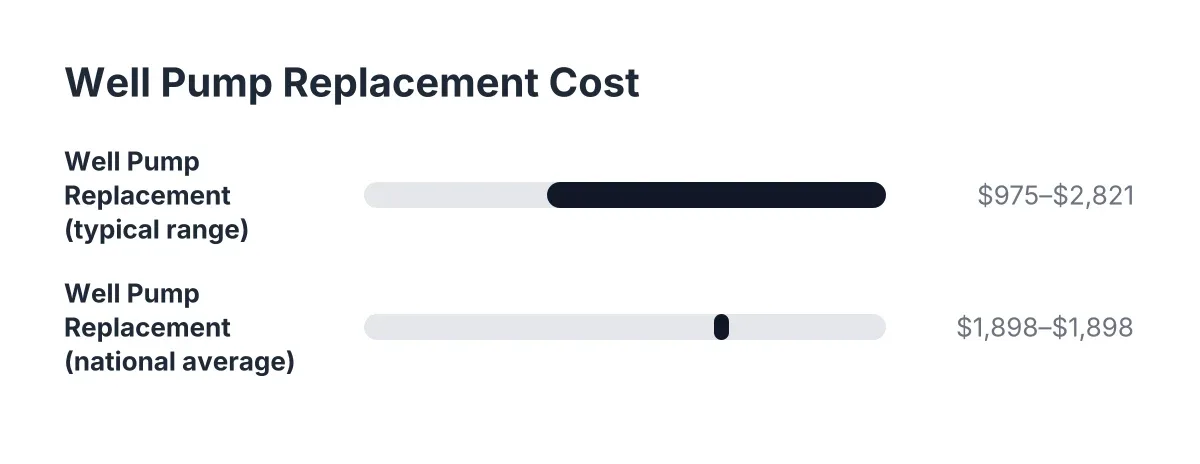
You cannot confirm any of these three from the surface. That said, knowing which symptoms you observed helps enormously. Note whether the pump hums, clicks, or runs silently, and whether water returns after the pump rests for an hour. A pump that recovers after resting often signals a low water level rather than a dead pump. If it turns out the pump is done, the national average well pump replacement cost is $1,898, with most homeowners paying between $975 and $2,821, according to Angi. Our guide to what well pump troubleshooting costs breaks down where those dollars actually go.
Low Pressure and Short Cycling: Reading Your Pressure Tank
Weak water pressure rarely means the well is failing. More often, the pressure tank or the switch that controls it has drifted out of spec. Understanding how these two parts work together turns a mystery into a checklist.
Your pressure tank stores water under air pressure so the pump does not run every time you rinse a glass. The pressure switch turns the pump on at a low setpoint, typically 30 or 40 psi, and off at a high one, typically 50 or 60 psi. As a result, healthy systems show a slow, steady climb and fall on the gauge as you use water.
Low water pressure from a well usually comes from one of four sources. The pressure switch may be set too low. The tank may have lost its air charge. A clogged sediment filter may be choking flow. Or the pump itself may be weakening with age. For example, if pressure is fine at one faucet but poor at another, the problem is almost certainly in your household plumbing, not the well.
Common Well Pump Troubleshooting: What Short Cycling Tells You
A well pump cycling on and off every few seconds is one symptom you should never ignore. This pattern, called short cycling, almost always means the pressure tank has a waterlogged bladder or has lost its air charge. To put it simply, the tank can no longer buffer the system, so the pump kicks on for every small draw of water. Each start puts stress on the motor. Left alone, short cycling will burn out a pump years ahead of schedule, and it turns a modest tank repair into a full replacement bill.
You can run a quick check yourself. Tap the side of the tank from top to bottom. The top should sound hollow and the bottom should sound dull. If the whole tank sounds dull and full, the bladder has likely failed. Beyond that, you can check the tank's air charge with a tire gauge at the valve on top, but only after shutting off the pump and draining the system pressure. If any of that feels outside your comfort zone, note the symptoms and let a technician verify it. Either way, catching short cycling early is one of the cheapest saves in well ownership.
Electrical Faults and Water Quality Changes: The Warning Signs That Need a Pro
Some symptoms are safe to investigate on your own. Others tell you to stop and pick up the phone. Electrical problems and sudden water quality changes both fall in the second group, but knowing what they mean still puts you in a stronger position.
A well pump tripping the breaker repeatedly signals a serious fault somewhere in the circuit. The motor windings may have shorted, the wiring down the well casing may have chafed through, or a control box capacitor may have failed. Because submersible pump circuits run at 240 volts and often carry current hundreds of feet underground, this is not a DIY repair. However, you can still help the diagnosis. Note whether the breaker trips instantly or after the pump runs a while. An instant trip usually means a dead short. A delayed trip often points to an overheating motor or a pump straining against a blockage. That single detail can save a technician real diagnostic time, which matters when troubleshooting visits are billed by the problem's location.
Sudden Sediment, Sand, or Cloudy Water
Sediment in well water that appears suddenly deserves the same respect. Sand or grit showing up after years of clear water often means the pump has dropped closer to the bottom of the well, the well screen has degraded, or the aquifer level has fallen and the pump is pulling from the silty zone. Additionally, cloudy water after heavy Oregon winter rain can signal surface water entering the well through a compromised casing or seal. That is a health concern, not just a nuisance, because surface water carries bacteria straight past the ground's natural filtration.
With this in mind, stop drinking the water until you test it, and describe exactly when the sediment started. The EPA estimates more than 23 million U.S. households rely on private wells, and a USGS study of 2,100 wells found about one in five contained a contaminant above a human-health benchmark. Private well owners carry the testing responsibility themselves, and the EPA's private well guidance is a solid starting point for what to test and how often. Locally, a professional well inspection typically runs $250 to $550, per Angi, which is modest insurance for the system your household drinks from every day. Sudden sediment paired with falling pressure is also worth mentioning to your technician, because the two together often point to a dropping water level rather than a pump fault.
Ready to Get Started?
If you have worked through these checks and still have no water, weak pressure, or a breaker that will not hold, you now know enough to describe the problem like a pro. Our team handles well pump troubleshooting, repair, and replacement across Gresham, Sandy, Boring, Damascus, Estacada, Corbett, and Oregon City, and we will tell you plainly whether you need a quick fix or a bigger repair. Call us with your symptoms, and we will get your water flowing again.