Well Drilling for New Construction in Gresham, OR: Residential vs. Commercial Needs
If you are planning a build on the rural edge of the east Portland metro, well drilling for new construction is one of the first decisions that can make or break your budget. The equipment, crew, and process for a residential well are not the same as what a commercial project needs, and the well drilling company you hire should match the job in front of you. This guide walks through the difference, what the drilling process actually looks like on a Gresham-area site, and how to vet a well contractor before you sign anything.
That last part matters more here than most places. Search for a well drill company near me in Gresham, OR and you will mostly find bare homepages and directory listings with no real information behind them. This article gives you a vetting framework so you can tell a real local operator from a templated listing, whether you are building one house or buying a rural rental with a well of unknown condition.
Why Drill Before You Build, Not After
Most property owners do it backwards. They buy the land, start the house, and hope adequate water shows up when the driller finally arrives. That order puts your entire construction budget at risk, because the one thing you cannot change about a property is what sits underneath it.
A smarter sequence is to drill the well first, or at minimum drill a test well, before you commit serious money to the structure. Drilling early tells you two things: whether the aquifer under your parcel can supply the home, and what it will cost to reach it. If the answer is disappointing, you still have options. You can relocate the building site, adjust the design, or in the worst case walk away before foundation money is spent.
For the rural investor evaluating a buildable lot near Sandy, Boring, Damascus, or Estacada, this is the single most useful piece of advice in this article. Water access is a line item you want confirmed before anything else on the budget gets locked in.
Residential vs. Commercial Well Drilling: What Actually Changes
Residential well drilling and commercial well drilling differ in rig size, crew size, well diameter, pump sizing, and the amount of testing required, not in the basic physics of reaching groundwater. A home well serves one household's peak demand. A commercial well may need to serve a rental complex, an irrigation system, a shop building, or a small business with fire-suppression requirements.
Residential well drilling: the typical setup
A residential water well in the Gresham area is usually drilled by a small crew, often around four workers, running a standard truck-mounted drilling rig. In smaller operations it is common for a CDL-licensed driver to move the rig to the site while one or two people handle the actual drilling. The well itself is a modest-diameter cased hole sized for a single household.
The finished system is familiar. According to the Indiana Department of Health, residential well systems typically use a submersible pump paired with a pressure tank, which may sit in the well, in the house, or in a crawl space depending on the home layout. Your well drilling contractor sizes that pump to the home's fixture count and the well's tested yield, not to a one-size-fits-all spec.
Commercial well drilling: where the requirements grow
Commercial projects change the math. A larger building, multiple units, or irrigation demand means a larger-diameter well, a heavier rig, more casing, and a pump system engineered for sustained draw rather than household peaks. Yield testing is longer and more formal, because the consequences of an undersized well multiply across every unit or process that depends on it.
For a landlord putting up a duplex or a small multi-unit building on well water, this distinction is the first qualifying question for any well contractor near you. Some outfits only run residential rigs. A driller who regularly handles commercial well drilling will talk comfortably about sustained-yield testing, larger pump systems, and how demand from multiple households stacks up on one well. If they cannot, keep looking.
What Well Drilling for New Construction Looks Like, Step by Step
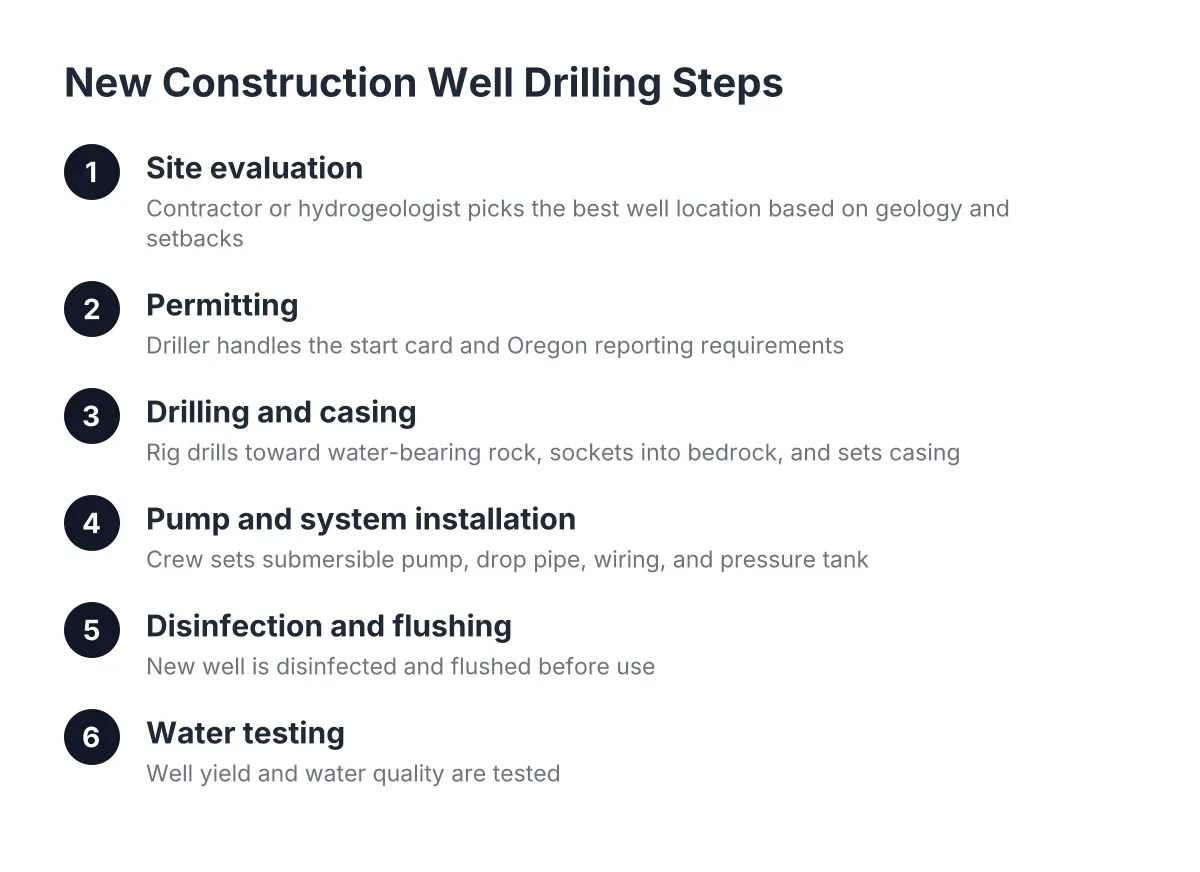
New construction well drilling follows a predictable sequence: site evaluation, permitting, drilling and casing, pump installation, disinfection, and water testing. Knowing the steps helps you spot a contractor who skips them. Here is the order of operations on a typical Gresham-area build.
- Site evaluation. Before anyone drills, a well contractor or hydrogeologist evaluates the parcel to pick the best well location. That decision weighs geology, required setbacks from septic systems and property lines, and permitting rules. It also has to account for access, because a drilling rig needs a clear, stable path to reach and maneuver at the chosen spot.
- Permitting. Oregon regulates well construction, and your driller handles the start card and reporting requirements. We cover the county-level details in our separate guide on well drilling permits in Gresham, OR.
- Drilling and casing. The rig drills through soil and overburden toward water-bearing rock. According to the New Hampshire Department of Environmental Services, when a drill hits the top of bedrock, drillers plan to go at least about 10 feet into that rock to seal off dirty surface water and create a proper socket for setting casing. Experienced drillers also keep going after first hitting water, both to confirm the flow holds steady and to add depth for sediment settling and future reserve.
- Pump and system installation. The crew sets the submersible pump, runs the drop pipe and wiring, and connects the pressure tank. Well pump installation is where sizing decisions made earlier either pay off or come back to bite you.
- Disinfection and flushing. According to the San Diego County Department of Environmental Health, after a new well is drilled the driller disinfects the well and pump components with bleach or chlorine, and the well should then be run heavily to flush the chemical taste and residue out before regular use.
- Water testing. It is standard practice, per the CDC, to take a water sample after drilling and to run the well extensively beforehand so the sample reflects normal water quality rather than lingering disinfectant. Do not accept a water test pulled an hour after chlorination. It tells you nothing.
A contractor who can walk you through this sequence without prompting, in plain language, has done it many times. A listing with a phone number and no process to describe has not earned your deposit.
What New Construction Well Drilling Costs in 2026
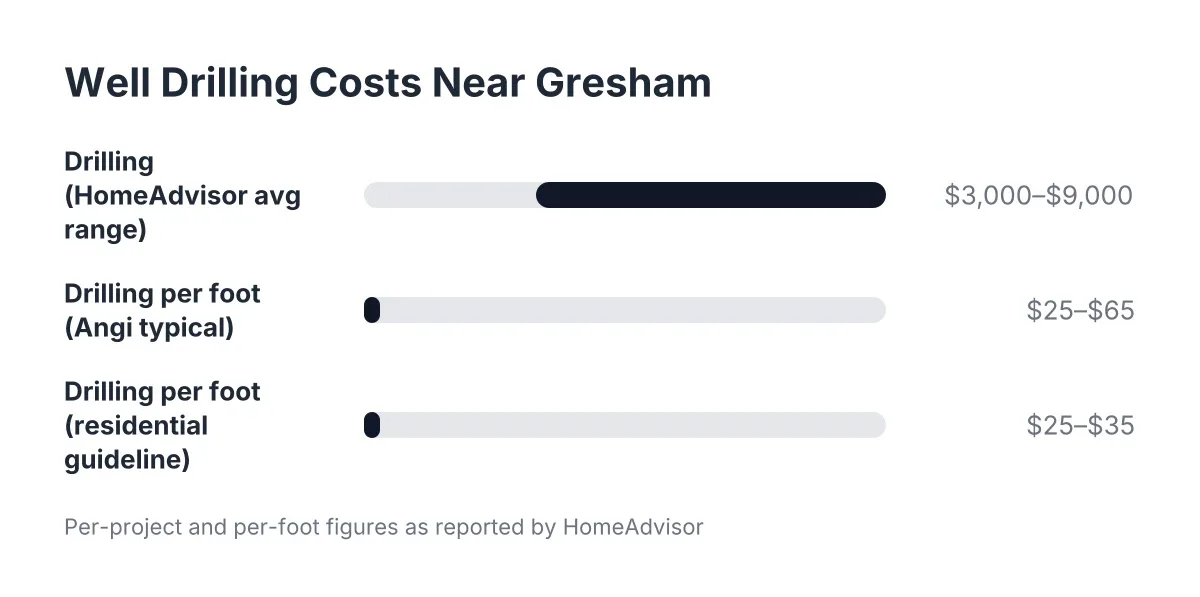
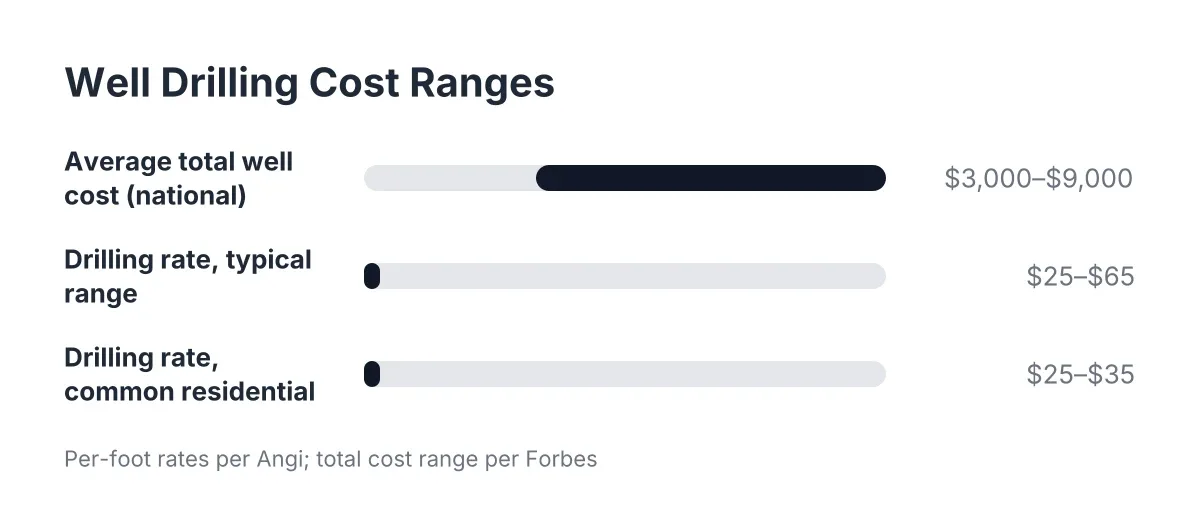
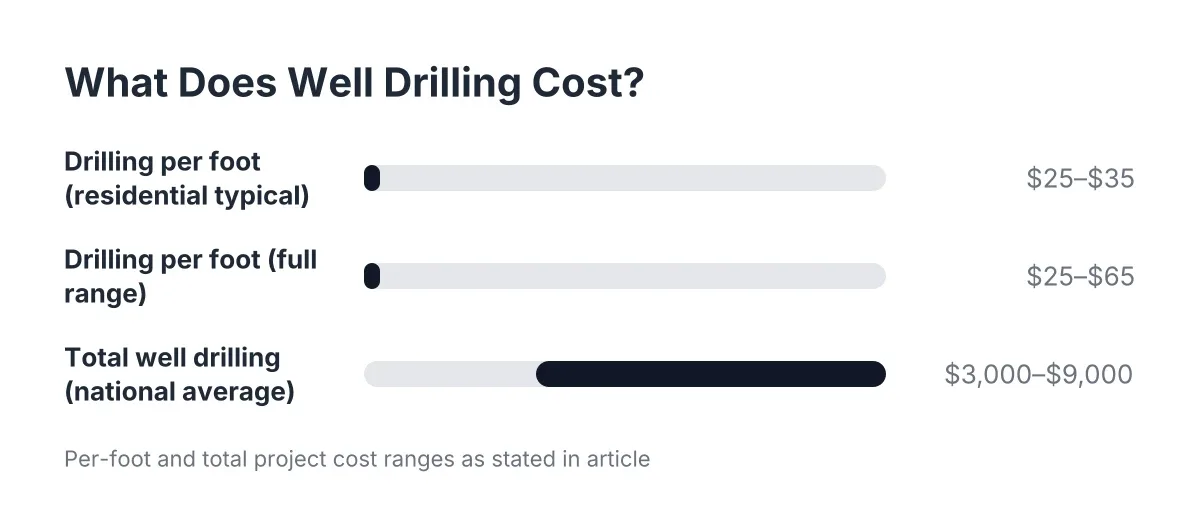
The cost of well drilling for new construction is driven mostly by depth, which nobody can promise in advance. National figures give you a starting frame. According to Angi, the average cost to drill a well runs $25 to $65 per foot, with $25 to $35 per foot as a typical guideline for most residential projects. HomeAdvisor puts the average total at $5,500, with most homeowners spending $3,000 to $9,000; Forbes lands close by at a $5,625 average.
Treat those as national reference points, not Gresham quotes. Local depth to water, the rock your site sits on, casing length, and pump system size all move the number. Commercial wells cost more than those residential figures almost across the board, because everything scales: diameter, casing, pump horsepower, and testing time.
A few cost factors worth asking any driller to explain for your specific site:
- Depth to usable water. The biggest variable, and the reason per-foot pricing matters more than a flat quote.
- Geology. Drilling through hard rock near the surface takes longer than drilling through soil, and time is money on a rig.
- Casing and sealing requirements. More overburden means more casing before the drill ever reaches rock.
- Pump system sizing. A deeper well or a commercial demand profile needs a bigger pump and tank. For context on the replacement side, Angi reports a national average well pump replacement cost of $1,898, with most homeowners paying between $975 and $2,821.
- Site access. If the rig cannot get to the ideal spot, you either pay for access work or drill a less ideal location.
One more planning note: HomeAdvisor notes that most owners need to drill or re-drill a well every 10 to 20 years. If you are a landlord holding properties long term, that lifecycle belongs in your total cost of ownership math, not just the initial build budget.
For a deeper breakdown of pricing, see our companion article on what hiring a well driller costs. The short version is that honest drillers explain the per-foot structure and the unknowns up front, and the ones to avoid quote a suspiciously tidy flat number before seeing your land.
How to Vet a Well Drilling Company Near Gresham, OR
Vetting a well drilling company comes down to three checks: verify they are licensed to construct wells in Oregon, confirm they have drilled in your specific area, and test whether they explain the process and costs in plain terms before asking for money. A real local operator passes all three in one phone call.
Here is the problem with searching for water well companies near me in this market. Most of what ranks is a brand name, a phone number, and a stock photo of a rig. Directory listings aggregate the same thin profiles. None of that tells you whether the outfit on the other end has drilled through the ground conditions east of Gresham or whether they are routing your call from three counties away.
Questions to ask a well driller before you sign
Ask these, and listen for specifics rather than reassurance:
- Is your company licensed to construct wells in Oregon, and will you file the well log with the state?
- Have you drilled in my area, and what did you typically run into for depth and geology on nearby parcels?
- How do you price, per foot or flat, and what happens to the price if you hit hard rock or need extra casing?
- Who sizes and installs the pump system, you or a subcontractor?
- What does your disinfection and water testing procedure look like after the well is complete?
- For commercial or multi-unit work: how do you test sustained yield, and have you sized systems for more than one household on a single well?
Red flags when hiring a well contractor
The same patterns show up in bad outcomes. Watch for a driller who quotes a firm total price before visiting the site, dodges the Oregon licensing question, cannot name nearby roads or communities where they have drilled, or pressures you to skip the post-drilling water test. In addition, be cautious of anyone who treats pump sizing as an afterthought; well pump installation done wrong is the most common reason a brand-new water well disappoints its owner.
A note on neutrality, since many readers here are evaluating a well during a home purchase rather than drilling fresh. The same vetting logic applies to a well inspection. You want a well and pump specialist who documents condition, estimated remaining pump life, and water quality in a written report, not someone whose inspection exists to sell you a new well. According to Angi, a typical professional well inspection costs $250 to $550, which is small insurance against a property-sized mistake.
A Hypothetical Build: One Lot, Two Very Different Wells
Suppose an investor buys a two-acre parcel outside Boring with plans for a single rental house, then later considers adding a second unit. For the first phase, a typical residential crew drills a standard-diameter well, cases it into rock, sets a submersible pump matched to one household, and hands over a water test report. Say the drilling and pump system together land somewhere in the mid four figures to low five figures, depending on depth; that is an illustrative range, not a quote.
Now the second unit changes the picture. In that scenario, the existing well's tested yield might cover both households, or it might not. The owner needs a sustained-yield assessment before framing begins, and possibly a larger pump, a bigger pressure tank, or a second well. A driller who handles both residential and commercial well drilling can run that assessment and give a straight answer. A residential-only outfit may just shrug, and a shrug at that stage can cost a season of vacancy.
The lesson for anyone managing well drilling new construction decisions across multiple properties: match the contractor's equipment and experience to the demand you expect at full build-out, not the demand on day one.
Timing, Weather, and When to Call a Professional
Timing your drill matters in this climate. During stretches of hard cold, outdoor drilling becomes impractical, and well contractors shift to shop work and repair calls instead. Therefore, if your construction schedule has a well on the critical path, book the drilling window early rather than assuming a rig will be free the week your excavator finishes.
There are also limits to what any article can tell you. Ground conditions change from one parcel to the next, even on the same road, and nobody can promise depth or yield before the drill confirms it. For siting decisions on complicated parcels, steep ground, or lots near existing septic systems, bring in a licensed well contractor or hydrogeologist before you commit to a building footprint. The cost of that evaluation is trivial next to drilling in the wrong place.
The Bottom Line for Gresham-Area Builders and Buyers
New construction well drilling rewards the people who do it in the right order: evaluate the site, drill or test before building, size the system for real demand, and verify everything with a documented water test. Residential and commercial jobs share that sequence but differ in scale, and the well drilling company you choose should have experience at the scale your project needs.
When you compare providers, skip the thin directory listings and press for specifics: Oregon licensing, local drilling history, per-foot pricing logic, and a written process for disinfection and testing. A real local operator in the Gresham, OR area answers those questions without flinching. That is the difference between hiring a phone number and hiring a well driller who will still pick up when your pump needs service ten years from now.
If you need well drilling, Clackamas Well Drilling can help.
Prefer to talk it through? Call (503) 782-5215 — a quick call is usually the fastest way to get a straight answer for your situation.